The individual’s playbook for the shift from doing the work to directing it.
By Kristian Kabashi
Most people are asking the wrong question about AI and their career. They are asking whether it will take their job. The question that actually decides their next ten years is different. Will they become the person who directs it, or the person it quietly replaces. The good news, and the reason I am writing this, is that this is a choice, not a fate. The blank collar is not a job title you get given. It is a way of working you can decide to learn, starting this week.
I write about all of this under that name, Blank Collar, the worker who sits on the other side of the AI wave, directing it rather than being washed away by it. Here is how you actually become one.
The one shift: from doing to directing
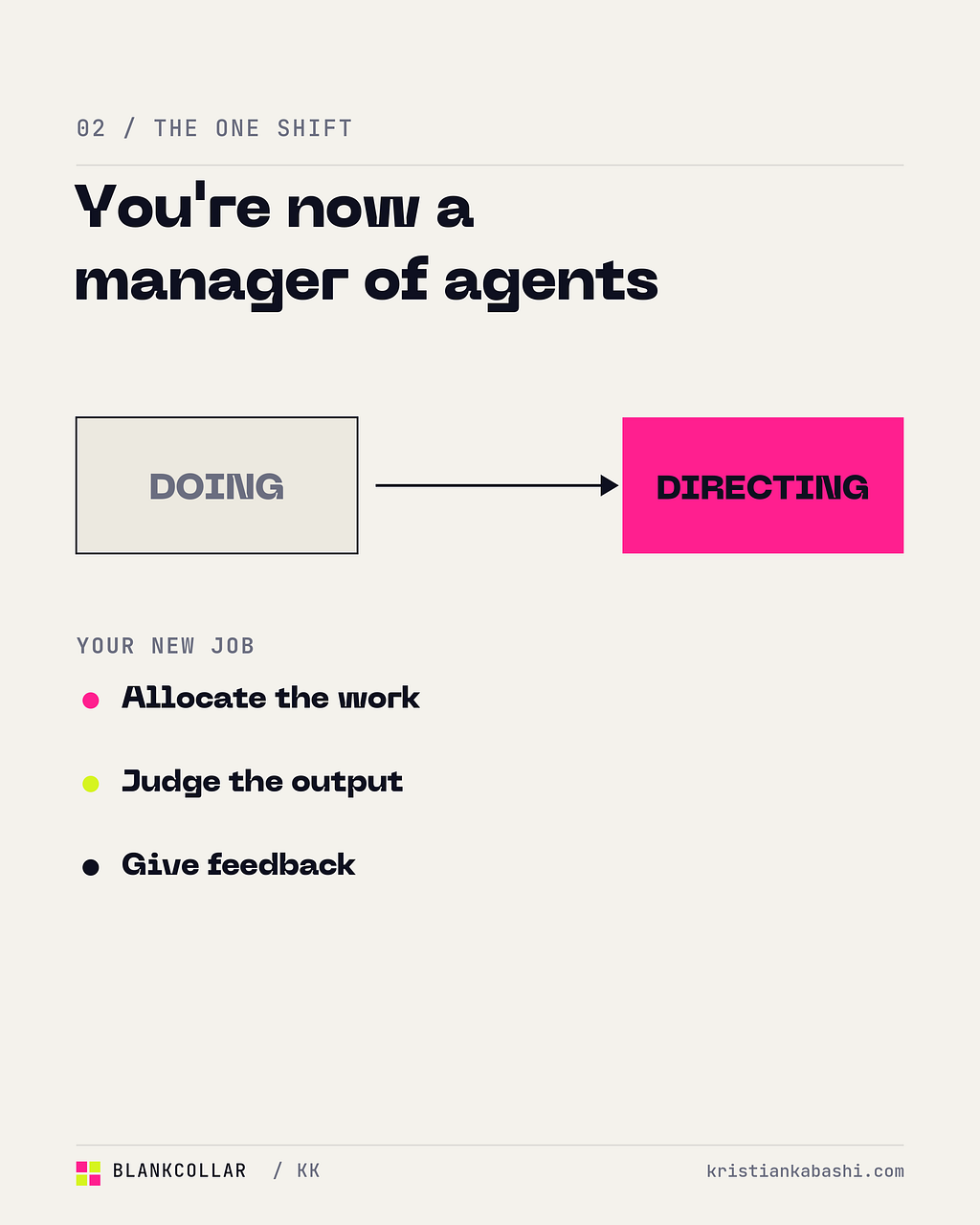
Everything starts with a single move, and once you see it you cannot unsee it. Your job is shifting from doing the work to directing the work. In a world with capable agents, every knowledge worker quietly becomes a manager. Not a manager of people necessarily, but a manager of a small team of agents that can draft, research, analyse and build on your behalf.
This is a bigger change than it sounds, because most people have never managed anything. They have only ever done. And the skills of managing well, the ones good leaders spend years learning, are suddenly the skills everyone needs. Allocate the work clearly. Judge whether the result is any good. Give feedback that makes the next attempt better. If you can do those three things with a team of agents, you are most of the way to being a blank collar, whatever your title says.
Find your tier, then climb one
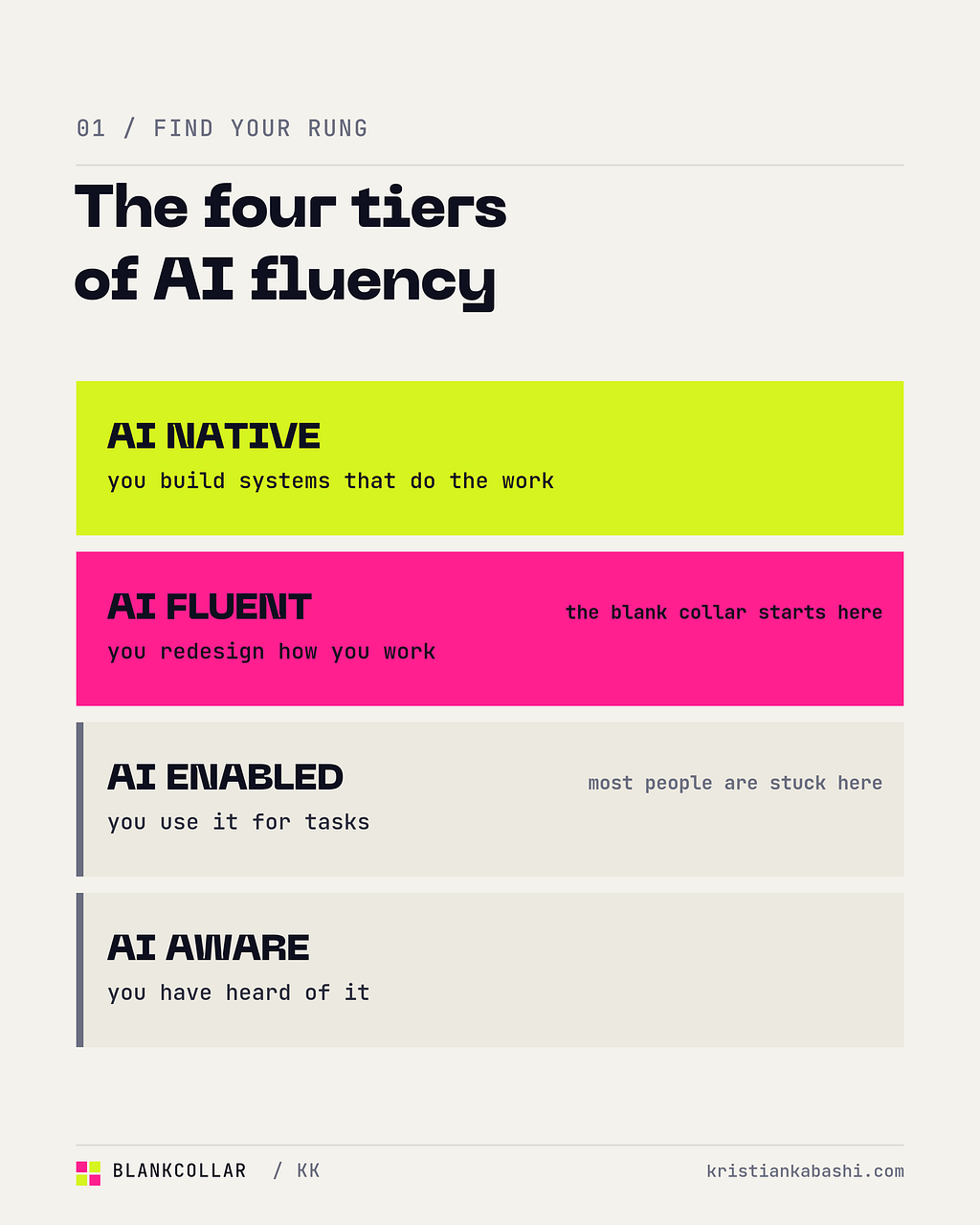
It helps to know where you actually stand, so here is the ladder the field has settled on. There are four rungs.
The first is AI aware. You have heard of it, you have poked at a chatbot, but nothing about your work has changed. The second is AI enabled. You use AI for individual tasks, a draft here, a summary there, and it saves you a bit of time. This is where most people are stuck, and it feels like progress, but it is not the real thing. The third rung is AI fluent. This is where you redesign how you work around AI, where whole parts of your week are now run differently, not just faster. And the fourth is AI native, where you build little systems and agents that do the work while you direct and decide.
The honest truth is that almost everyone is sitting on rung two, mistaking it for the summit. The blank collar begins at rung three, the jump from using AI on tasks to rebuilding how you work. And the encouraging part, which is backed by how people actually learn this, is that a deliberate plan can move you a full rung in about sixty days. This is not a five year reskilling programme. It is a season.
The skills that actually compound
Notice what is not on the list. You do not need to learn to code. The skills that compound for a blank collar are management skills and editorial skills, not technical ones.
The first is context, which has quietly replaced clever prompting as the thing that matters. The trick is not magic words. It is giving the agent the full picture of your situation, the same way you would brief a sharp new hire, so it produces something that fits your reality instead of a generic answer. The second is judgment, which is the whole game. Knowing when to trust what comes back, when to push back, when to fact check, and how to steer it toward something better. The third is building your own stack, a personal set of tools and a growing library of your own playbooks and prompts, so your output compounds instead of starting from zero every morning. Write down the thing that worked, and it works forever.
None of these require permission or a budget. They require reps.
The sixty day plan
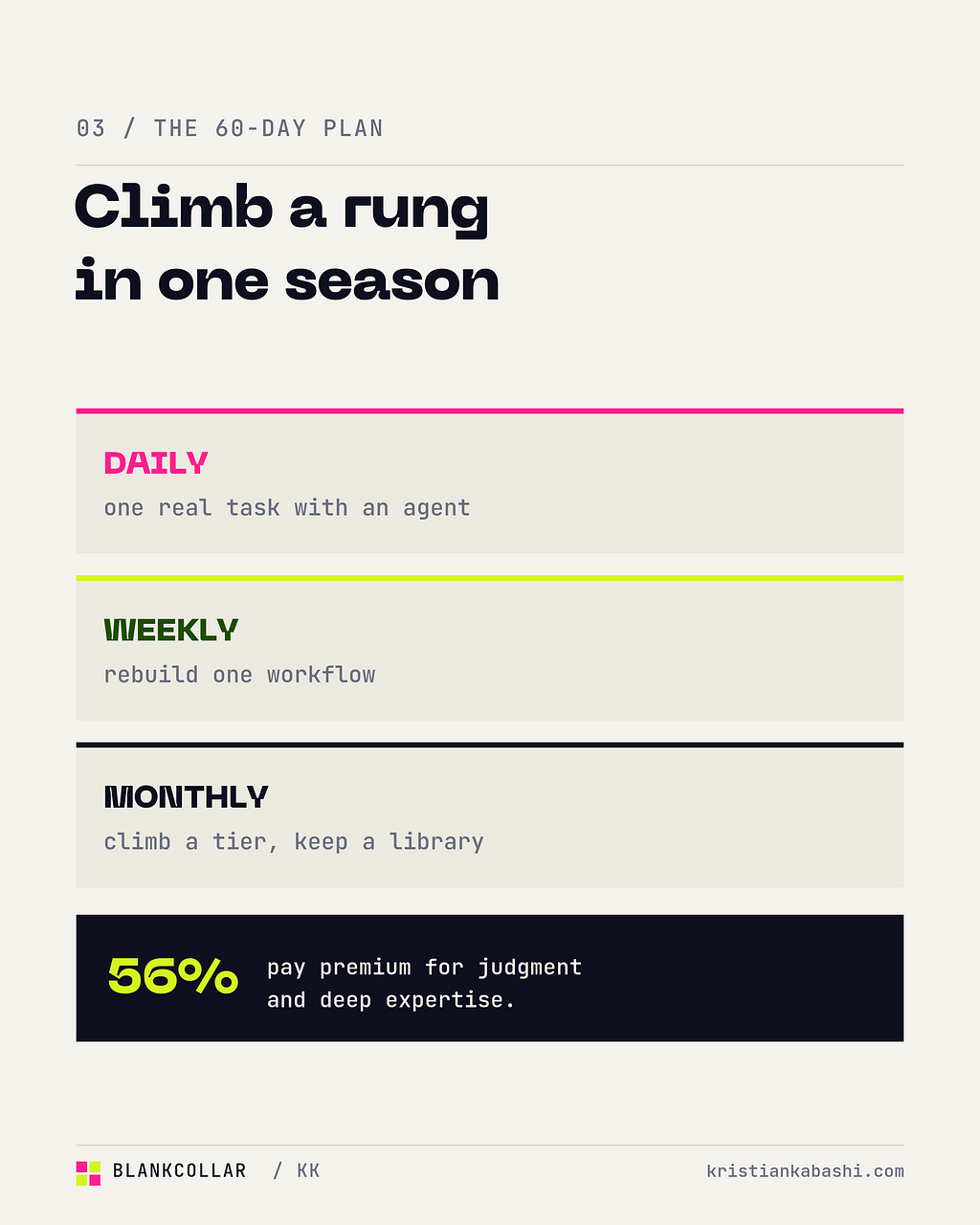
Here is the plan, and it is deliberately unglamorous, because the people who get good at this do boring things consistently while everyone else waits for a training course.
Every day, do one real piece of your actual work with an agent, start to finish, even when it would have been faster to do it yourself. The point is the reps, not the speed, and the speed comes later. Every week, take one recurring part of your job and rebuild it around AI properly, not just augment it, until that thing runs differently than it did. And every month, aim to climb a tier, and keep a running library of the prompts, the context, and the playbooks that worked, so you are compounding. Learn out loud with the early adopters around you, because in every company there are a few people already living on rung three, and an afternoon with one of them is worth a month of reading.
Why this is the safe bet, not the risky one
People think leaning into AI is the risky move and keeping their head down is the safe one. It is exactly backwards. The research on this is consistent. The premium is moving hard toward judgment and deep, role specific expertise, the very things a blank collar develops, with that combination now commanding something like a fifty six percent pay advantage and, not coincidentally, the strongest protection against being automated. You are not safe because you avoided AI. You are safe because you became the person who directs it.
And there is a part of this that no plan can give you, which is the part that matters most in the end. As the machines absorb more of the ordinary work, what stays valuable is the stuff they cannot fake. Taste. Judgment. The relationships you hold. The conviction to decide what is worth doing at all. Becoming a blank collar is really about clearing away the busywork so you can spend your days on those, the parts that were always the point of being a person at work.
So that is the individual move. Learn to direct, climb a rung, build your stack, protect the human core. But here is what happens when a few people who can actually do this get in a room together. They build things that used to take a hundred people. What a tiny team of blank collars can now run is genuinely hard to believe, and it is where this goes next.
Kristian Kabashi writes Blank Collar, a field guide for executives rethinking how their companies are built. More at kristiankabashi.com.
Sources: Built In, how to develop AI fluency · Computerworld, AI skills to develop in 2026 · Digital Applied, AI upskilling guide 2026