Product owner, UX designer, project manager. Fold them into one person and you get the role AI cannot do, because it is the role that runs the AI.
By Kristian Kabashi
People keep asking me the same question, in slightly different words. What should I study now. What should I reskill into. Should I learn to code before the window closes. They are usually surprised by my answer, because it is not a technology at all.
If I were twenty-two today, or if I were starting over at forty, I would not chase the newest model or the framework everyone is posting about. I would deliberately make myself good at three old, unglamorous things at the same time: being a product owner, being a UX designer, and being a project manager. Not so I could go and get three jobs. So I could become the single job that is quietly forming in the overlap of all three. I have started calling that person the Conductor, because the work is exactly that. The execution is moving to the machines. What stays with us is knowing what to build, knowing how it should feel, and being able to run a crowd of agents that build it. Those three skills, fused into one head, are about the most future-proof thing I can picture right now.
Let me make the case, because I think it is the most useful thing I can tell anyone who is worried about where they fit.
The job is changing shape, not vanishing
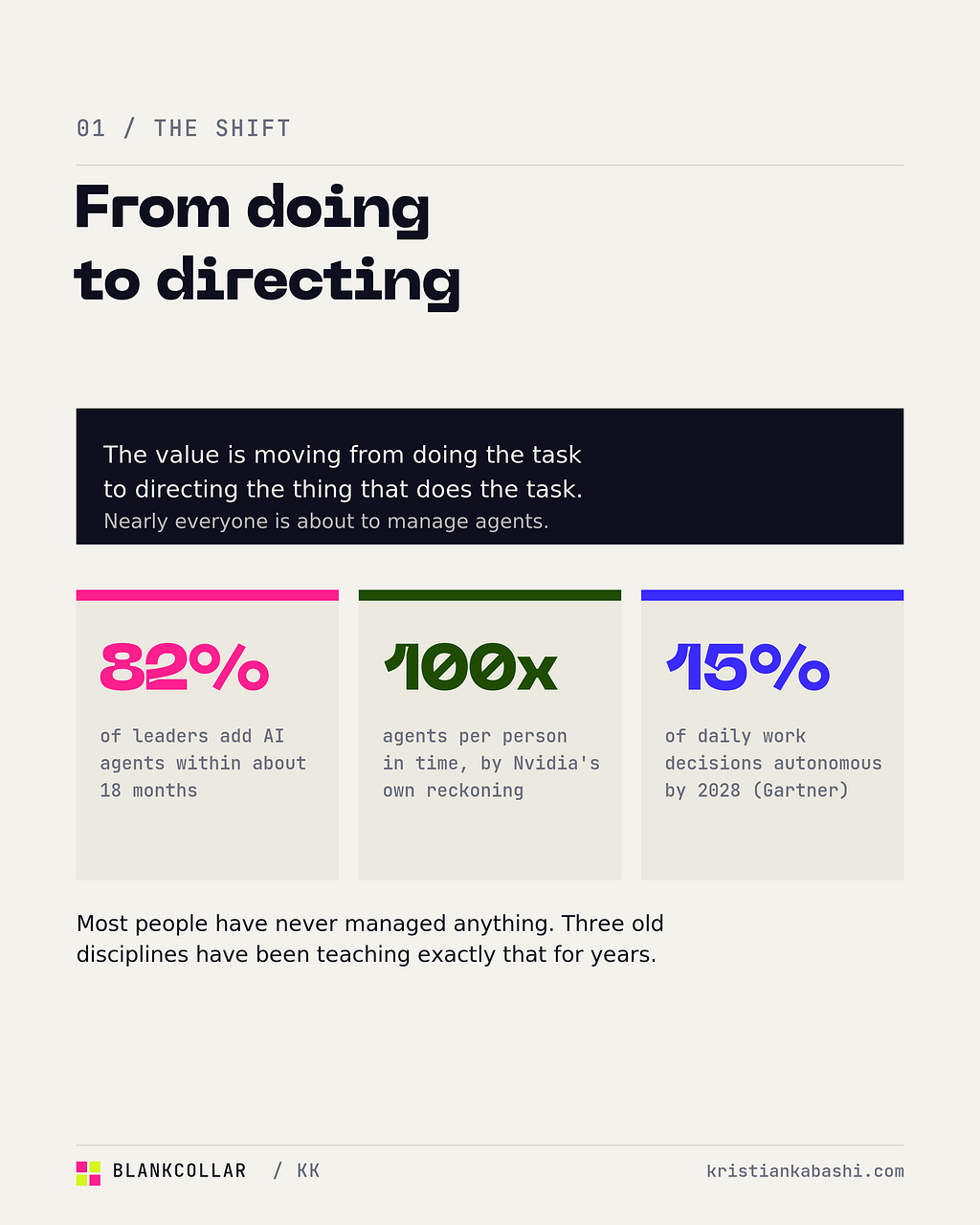
Start with what is actually happening, underneath the noise. The value in knowledge work is sliding away from doing the task and toward directing the thing that does the task. This is not a fringe view anymore. Karim Lakhani at Harvard put the bumper-sticker version of it back in 2023, that AI will not replace people, but people using AI will replace people who do not. Reid Hoffman, when asked recently what the core skill becomes, landed on a single word, orchestration. Ethan Mollick, who studies this as closely as anyone, framed it more sharply still. The talent, he says, is suddenly abundant and cheap. What is scarce now is knowing what to ask for.
And it is arriving fast. In Microsoft’s 2025 workforce survey, something like 82 percent of leaders said they expect to use AI agents to expand what their teams can do within a year or so. They started using a telling phrase for the worker who manages those agents, the agent boss, and suggested everyone will need to start thinking like the head of a small, agent-powered company. Jensen Huang likes to say that in time each of his people might work alongside a hundred digital ones. Take that even half seriously and the conclusion is plain. Most of us are about to be managing a team, possibly a large one, made of software.
Here is the uncomfortable part. Most people have never managed anything. They have done tasks, and done them well, but they have never had to decide what a team should work on, judge whether the output is any good, or keep ten things moving at once without dropping the important one. That is the gap. And it turns out three existing disciplines have been teaching exactly those muscles for decades.
Skill one, the product owner: turn a fuzzy want into a clear instruction
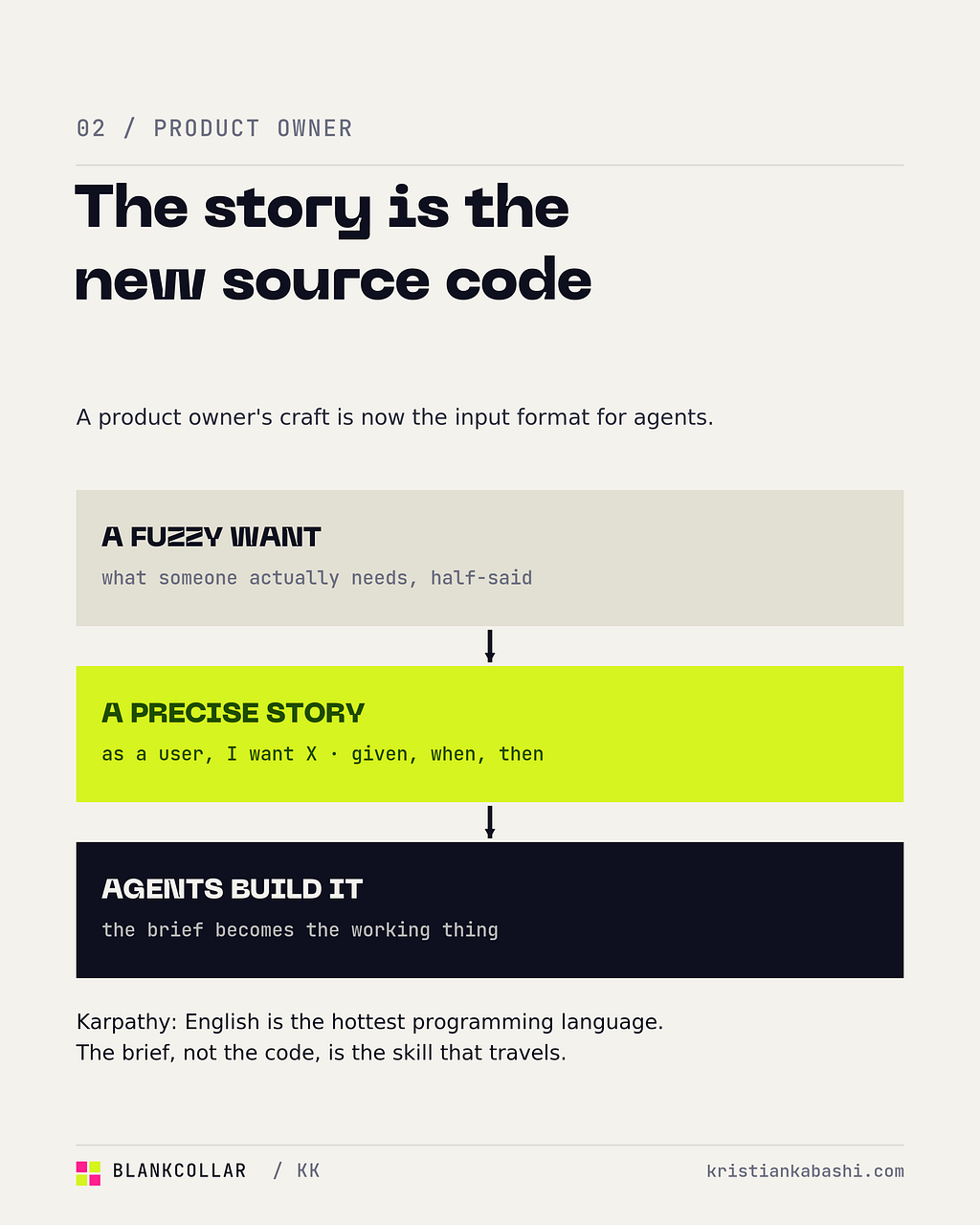
The core craft of a good product owner is not running ceremonies or grooming a backlog. It is sitting with a customer, or a colleague, or a confused stakeholder, pulling out what they actually need underneath what they are saying, and writing it down so precisely that someone else can build it without a dozen follow-up questions. The humble user story, the “as a user I want this so that I get that,” with clear conditions for when it counts as done. That used to be a way to brief a team of human developers.
Now it is the literal input format for the machines. This is the part that still surprises people. The most valuable technical skill of this moment is not writing code, it is writing the thing the code gets generated from. Andrej Karpathy said it early and bluntly, that “the hottest new programming language is English.” A year and a half later an OpenAI engineer gave a talk arguing that specifications, not code, are becoming the real unit of programming, and that the person who can communicate intent most clearly is becoming the most valuable builder in the room. The new wave of coding tools makes this almost literal. One of the most popular, Amazon’s Kiro, starts you off by writing requirements as user stories with given, when, then conditions, the exact format a product owner has always used. The spec became the source code.
So the skill that got dismissed for years as mere paperwork is now the most valuable one you can build. If you can describe what you want and how you will know it is right, you can direct any agent toward it. If you cannot, the smartest model on earth will confidently build you the wrong thing in record time. I have watched both happen. The difference was never the model. It was the brief.
Skill two, the UX designer: shape the experience, because that is all that is left to compete on
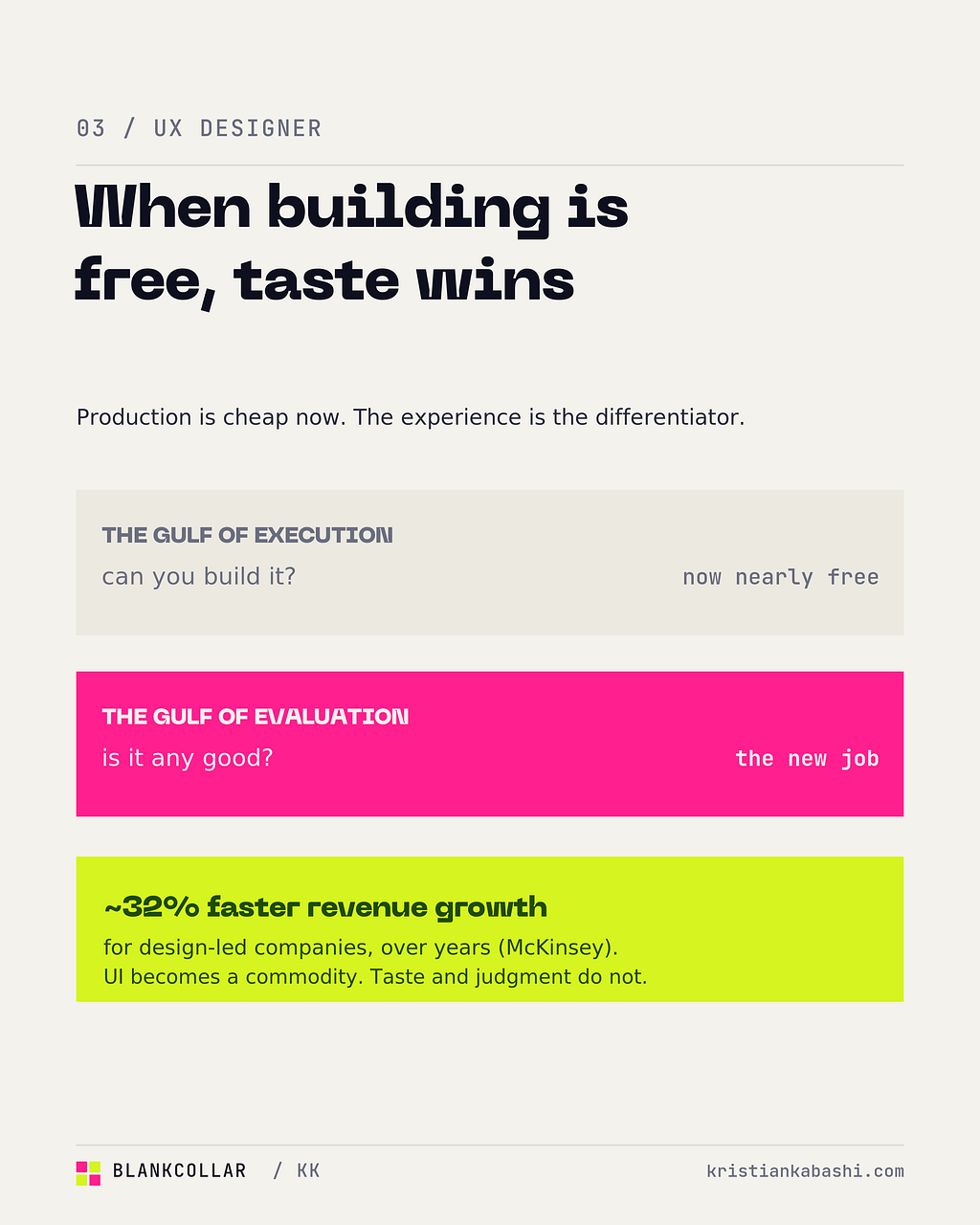
The second skill people underrate even more, and I think it is about to become central to almost every job, not just design. Here is the logic. When making something becomes nearly free, making it stops being the differentiator. Everyone can now produce a clean landing page, a passable app, a competent campaign. So what separates the thing people love from the thing they ignore is no longer whether you can build it. It is the experience, the taste, the hundred small decisions about how it feels to use.
The research backs this up more than I expected. McKinsey’s long study of design-led companies found they grew revenue meaningfully faster than their peers over years, not months. The Nielsen Norman Group, who are not given to hype, now say plainly that the surface layer is becoming a commodity, and that what cannot be automated is taste, judgment, and the contextual sense of what is actually good. John Maeda, in his design report this year, described the shift beautifully. The hard design question used to be helping someone do a thing. It is becoming helping someone know whether the thing was done well. When an agent can do the work but cannot be trusted to judge its own output, the human who can judge becomes the most important person in the loop.
And UX is no longer just screens. It is the whole experience of a product, a brand, a sales journey, a support conversation, increasingly a conversation with an agent acting on your behalf, where trust itself becomes a design problem. The person who can map an experience end to end, and who has built the taste to feel the difference between fine and excellent, is the one who turns raw machine output into something a human actually wants. I wrote a whole piece arguing that taste is the new moat. This is where you build it.
Skill three, the project manager: run many things at once without dropping the one that matters
The third skill is the one I suspect is most fundamental of all, and the most overlooked, probably because project management has the least glamorous reputation of the three. That reputation is about to look very outdated.
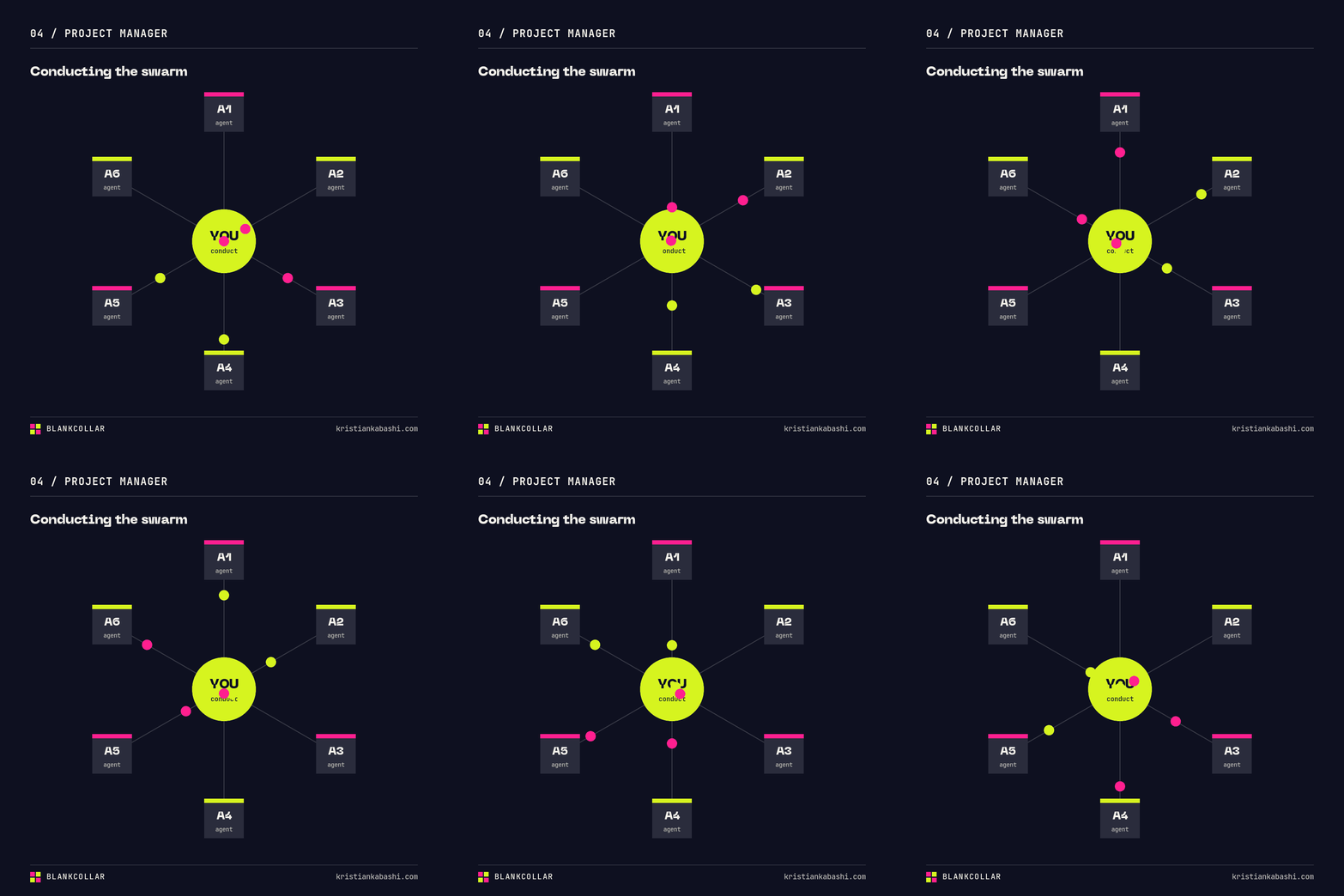
Think about what changes when you have agents. You no longer have one task in front of you. You have many, running in parallel, throwing off outputs and asking for decisions, all at once. That is a coordination problem, and coordination under load is precisely what project and delivery management is. Knowing what to do first and what to let wait. Breaking a big ambiguous goal into pieces small enough to hand off. Tracking what is in flight, spotting where one thing is blocking another, checking quality across a pile of parallel work, and pulling it all back together into one coherent result. Microsoft now talks about a human-agent ratio as a real management metric, how many agents per person and how many people to guide them. Marc Benioff put it more memorably, saying his generation will be the last to manage only humans. Even the agile world is feeling it, with scrum masters being recast as orchestrators of intelligence rather than minders of a standup.
There is a warning hiding in the data that makes the point for me. Gartner expects more than 40 percent of these agent projects to be cancelled within a couple of years. Not because the models are bad. Because of unclear goals, runaway cost, and weak oversight. That is a management failure, top to bottom. It is exactly the failure that someone with real project discipline prevents. When the latest workforce survey asked which human skills matter most as agents take over execution, the top two answers were quality control of the output and critical thinking. That is the project manager’s job, applied across a team that happens to be made of software.
Why the fusion beats any one of them
Now the important bit, because I am not really telling you to learn three separate jobs. I am telling you they have collapsed into one, and the collapse is the opportunity.
Watch how they fit. The product owner decides what gets built and why. The designer shapes how it feels and whether it is any good. The project manager runs how it gets done and how much of it can run at once. In the old world these were three different people who met in a room and argued, and the arguing, the handoffs, the translation between them, was slow but tolerable because the building itself was the slow part. That is no longer true. The building got fast. Now the handoffs between three humans are the bottleneck. The person who holds all three perspectives in a single head, who can define and design and direct without waiting for anyone, moves at the speed the agents can actually work. That person is the Conductor, and right now they are rare, which is exactly why I would become one.
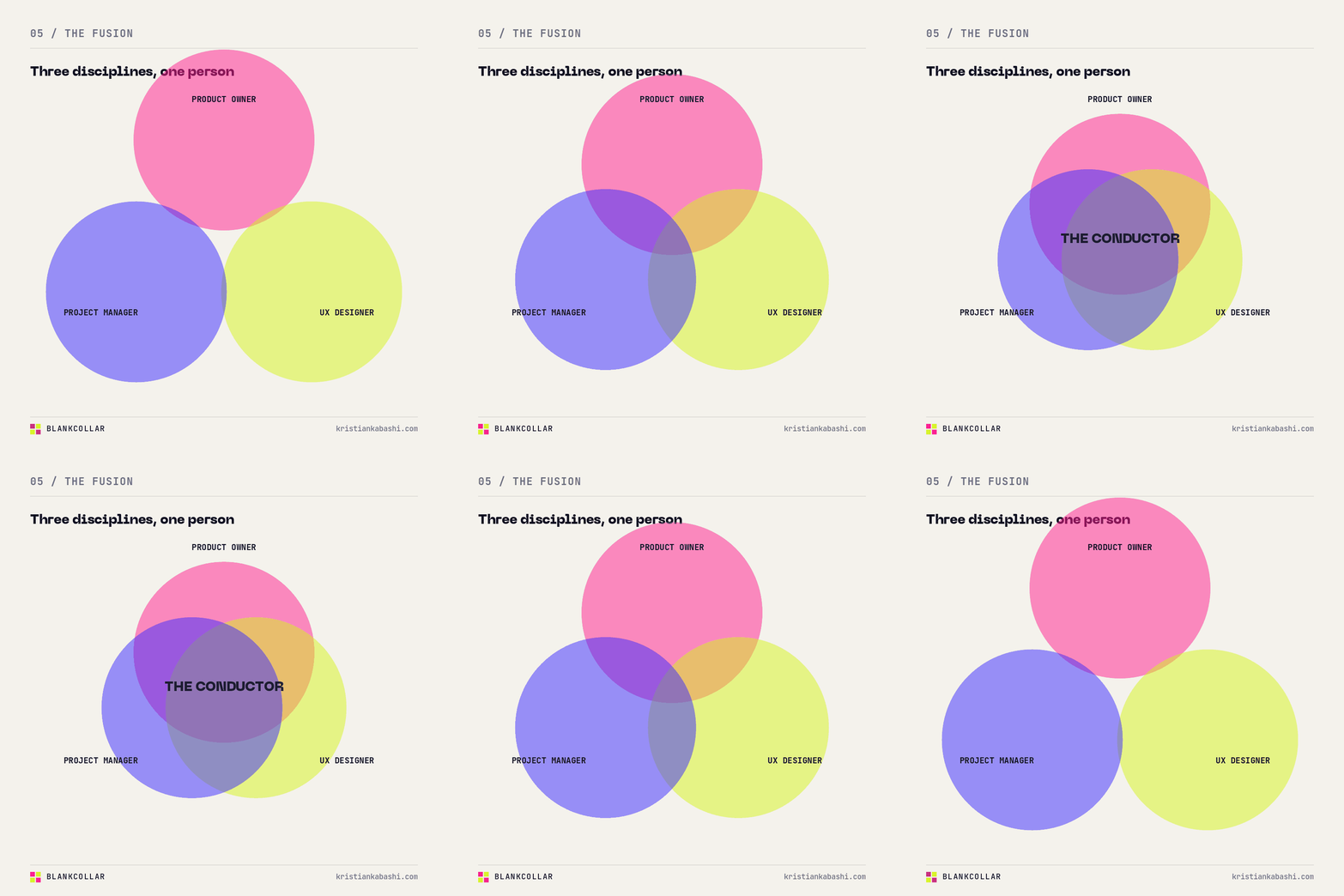
This is the blank collar’s actual job description
I have written a lot about the blank collar, the worker who directs rather than executes. This is the concrete version of it, the part I could never quite pin down before. A blank collar is not a coder, and it is not someone who types clever prompts. It is a Conductor. Someone who can take a vague human need, turn it into a precise brief, shape it into an experience worth having, and orchestrate a swarm of agents to deliver it, at quality, on time.
And notice what none of those three skills require. Not one of them needs you to be technical in the old sense. You do not need a computer science degree to write a clear story, to develop taste, or to run a project well. All three are learnable starting Monday, by almost anyone, which is the whole reason I find this hopeful rather than frightening. The barrier is not access to a fancy credential. It is whether you put in the reps.
How to actually start
So if this lands for you, here is what I would actually do, and none of it requires quitting anything or paying for a bootcamp.
Pick one real project you care about, because these skills do not stick in the abstract. Then practice the three muscles on it, on purpose. For the product owner muscle, force yourself to write a proper brief before you prompt a single thing, what you want, the constraints, and a clear picture of what done and good looks like. For the design muscle, stop obsessing over features and start obsessing over the experience, and study work you admire closely enough that you can say why it is better, not just that it is. For the project muscle, run three or four agents at once on something real, and make yourself prioritise, check their work, and stitch it together, which is harder and more revealing than it sounds. Do it on something that matters to you, a side business, a community project, a tool for your team. The skills compound, and the lovely thing is they transfer anywhere, into marketing, into a tiny startup, into a nonprofit, into a corner of a big company.
The reframe
People keep asking me which single skill will keep them safe, as if there is one quiet island the tide will not reach. I do not think there is one skill. I think there is a posture. Define clearly. Design with taste. Direct many. Get good at those three and you stop competing with the machine and start commanding it.
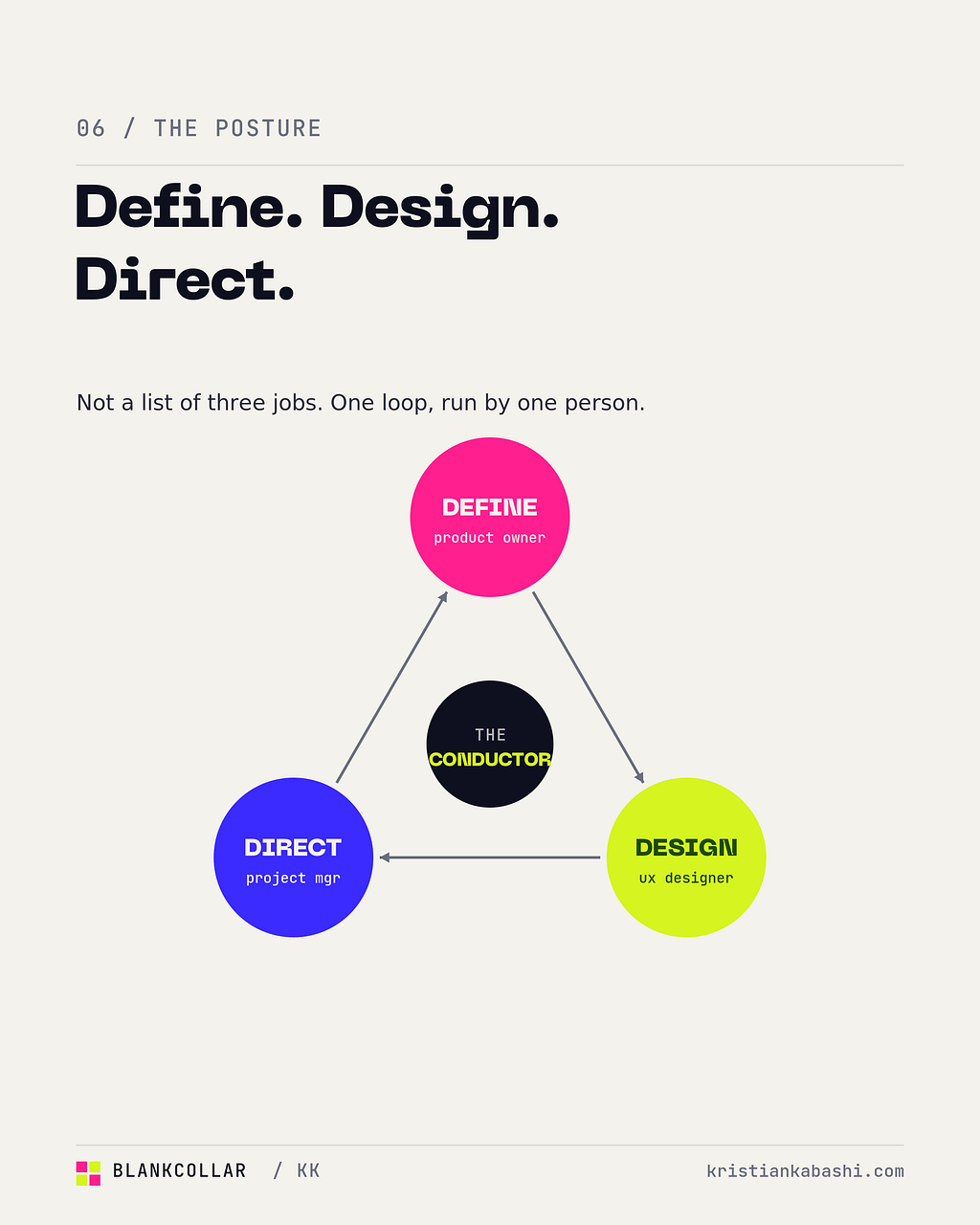
That is the job that does not get automated, because it is the job of automating. It is also, I think, a more interesting job than most of the ones it replaces, since it asks for judgment and taste and leadership rather than rote output. If I were starting over, with everything I now know about where this is heading, that is exactly where I would start. Work is for bots. Conducting them is for us.
Kristian Kabashi writes Blank Collar, a field guide for people trying to stay future-proof while the ground keeps moving. More at kristiankabashi.com.
Sources: Karim Lakhani, Harvard Business Review (2023) · Ethan Mollick, Management as AI Superpower · Reid Hoffman, predictions on orchestration · Microsoft Work Trend Index 2025, the Frontier Firm and the agent boss · Microsoft Work Trend Index 2026 · Andrej Karpathy on English as the new programming language · Sean Grove (OpenAI), The New Code · AWS Kiro, spec-driven development · Thoughtworks on spec-driven development · McKinsey, the Business Value of Design · Nielsen Norman Group, State of UX 2026 · John Maeda, Design in Tech 2026: From UX to AX · Gartner, over 40% of agentic AI projects cancelled by 2027 · Salesforce / Marc Benioff on managing humans and agents · World Economic Forum, Future of Jobs 2025 skills outlook