How lean, agent-native startups now outrun companies ten times their size, and how to build one.
By Kristian Kabashi
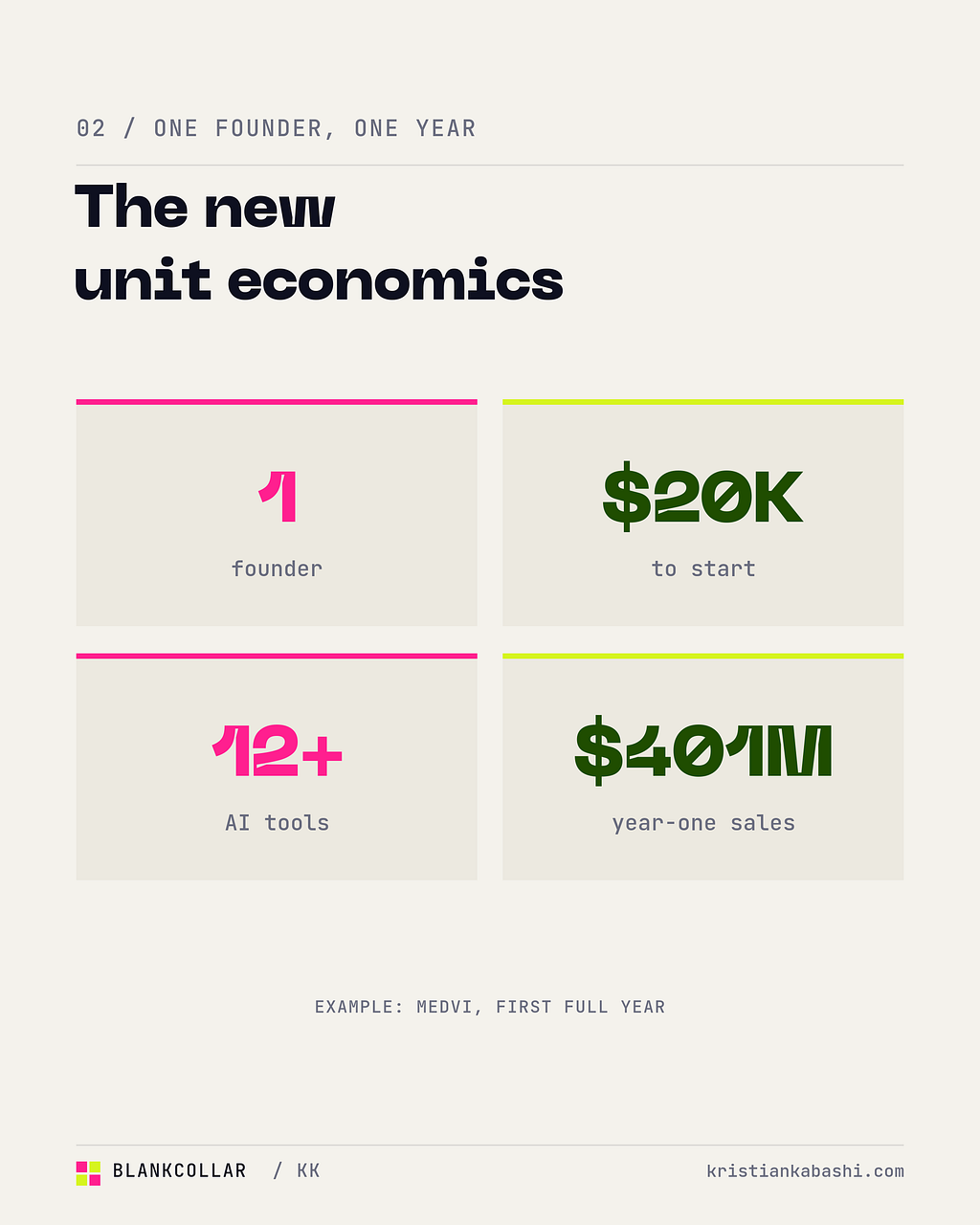
In late 2024 a man set up a health startup out of his home in Los Angeles with twenty thousand dollars, no employees, and a dozen or so AI tools. In its first full year, by the reporting on it, that company did around four hundred million dollars in sales, served a quarter of a million customers, and ran at a healthy profit. One founder. No team. A pile of agents doing the work.
You can argue about any single number, and you should be skeptical of the breathless version of these stories. But the direction is not in doubt, and it is the most important thing happening in business right now. The team of five that beats the team of fifty is not a motivational slogan. It is the new unit economics, and if you are building or running a company, it changes the math you plan with.
I write about this under a name I gave the idea, Blank Collar. Here is what is actually going on, and how to build for it.
The new scoreboard
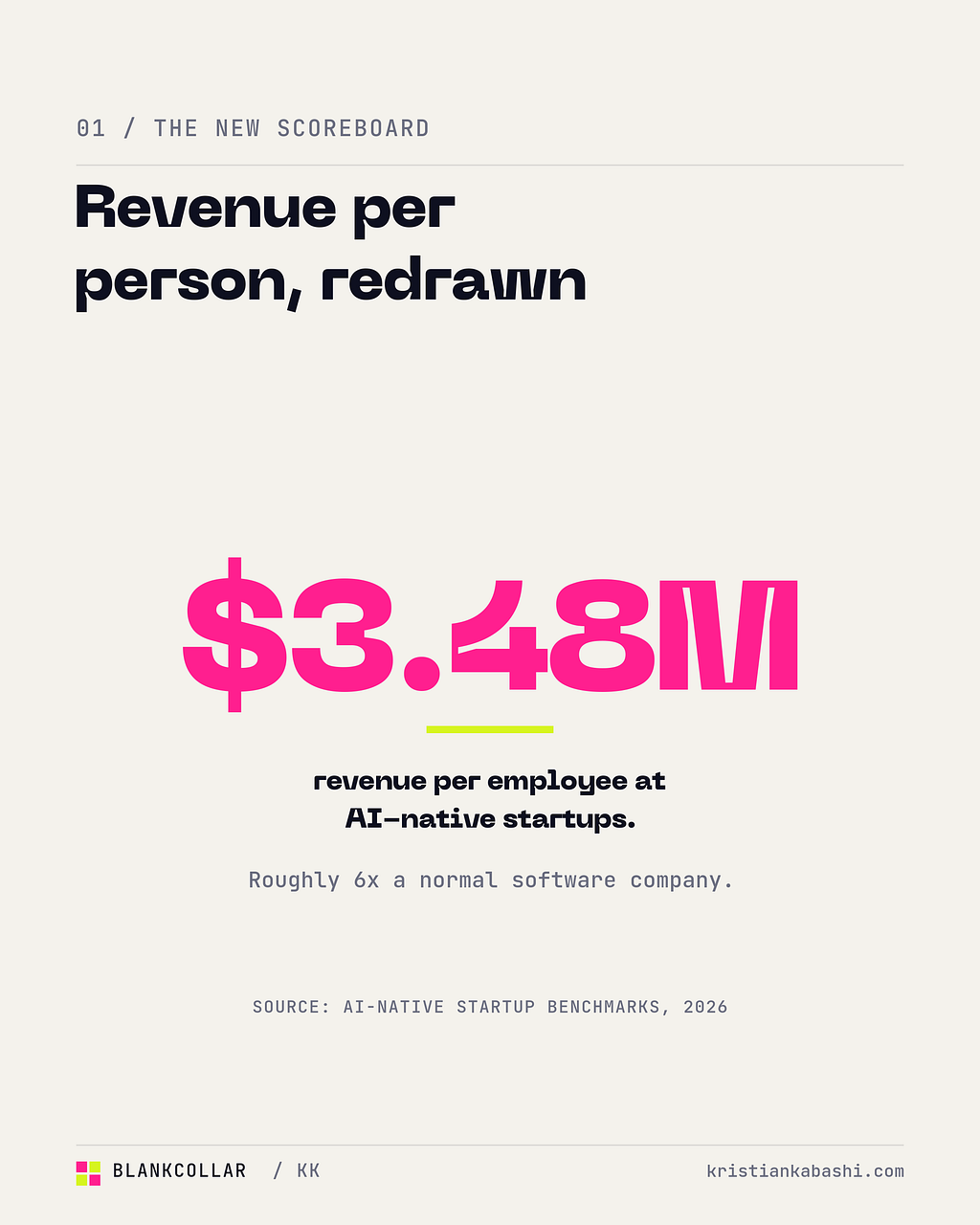
The number to watch is revenue per employee, and it has gone somewhere strange. Traditional software companies have long measured their output in the low hundreds of thousands of dollars per person. The AI native startups, the ones built around agents from the first day, are running at something like three and a half million dollars per employee, several times higher, with teams that are markedly smaller, reaching the milestones that matter a full year faster than their conventional rivals.
Sit with that gap. Same market, same customers, a fraction of the people, and multiples of the output per head. Revenue per employee used to be a metric the finance team looked at once a year. It is now the scoreboard for how well you have actually built your company.
Why it is different this time
Every efficiency wave promised to do more with less, so it is fair to ask what is new. Here is the honest answer. Earlier tools made a person faster at a task. Agents do something more radical. They remove the need for a dedicated person to own certain functions at all. That is the sentence that changes how you build a company.
You can see the extreme version of this inside the big technology firms, where one chip maker now reportedly runs on the order of a hundred AI agents for every single human employee. Most companies will not go anywhere near that ratio, and they should not try to. But the point stands. The question when you have a job to be done is no longer only “who do I hire.” It is now “should this be a person, an agent, or a person directing agents.” Ask that question on every role and the shape of the company you build changes completely.
The playbook
So how do you actually build one of these. Four moves.
First, build agent native from day one. The companies getting these numbers did not bolt AI onto a normal startup. They designed the whole operation around agents from the start, which is a structural advantage a legacy competitor cannot easily copy, because they would have to unbuild themselves first. If you are starting now, this is your edge. Use it before everyone does.
Second, make revenue per employee your north star, and defend it on purpose. Treat every single hire as a real decision, because each person you add brings not just salary but a coordination cost, the meetings and the context-sharing that quietly tax the whole team. The bar for a new human should be high precisely because a small senior team plus agents will usually out-ship a big team. One payroll company recently grew its revenue per person by half without adding a single head. That is the game.
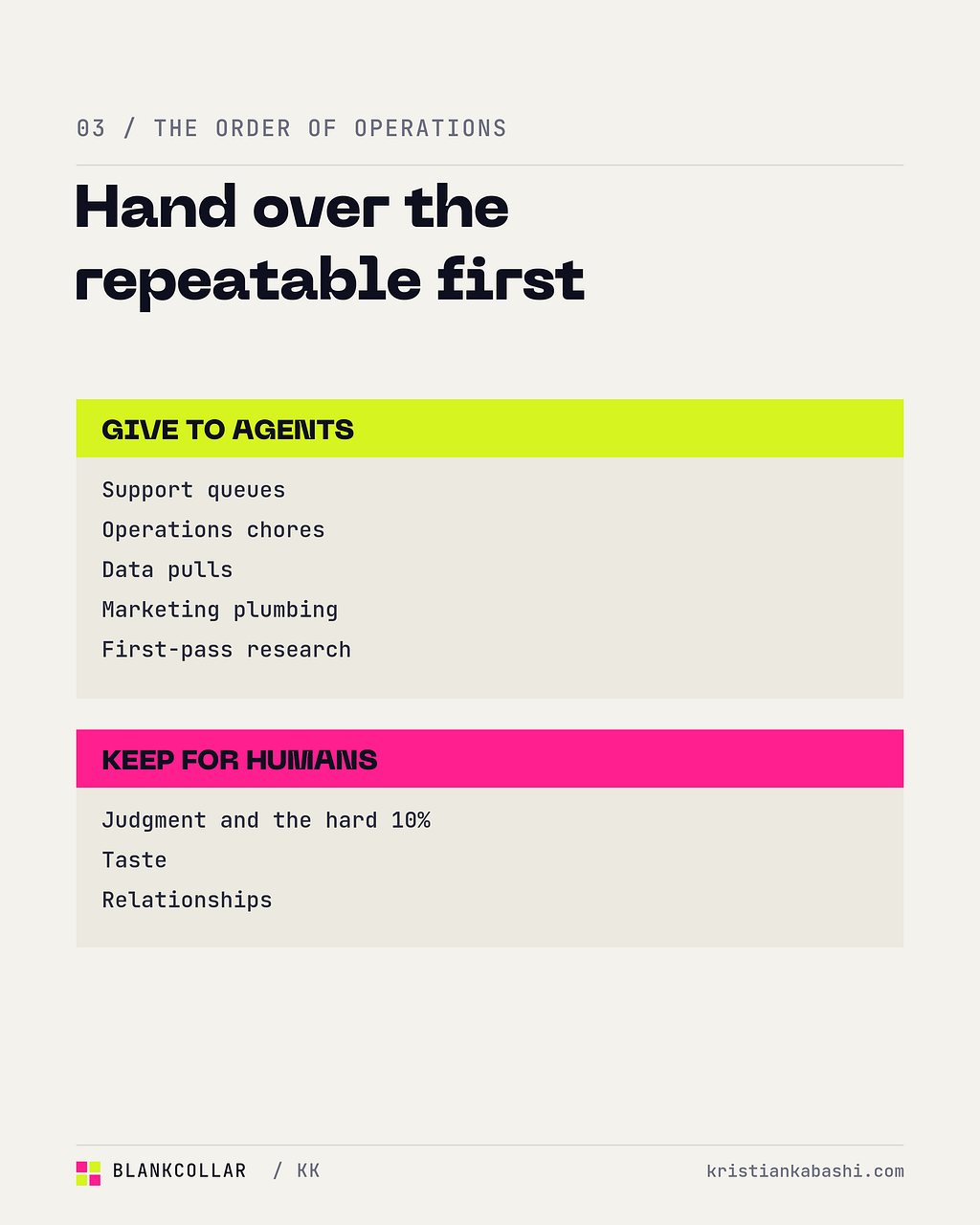
Third, hand work to agents in the right order. Do not try to automate everything at once. Start with the functions that are high volume, repeatable, and rules based, the support queues, the operations chores, the data pulls, the marketing plumbing, the first pass research. Keep your scarce humans on the hardest tenth of the work, the judgment, the taste, the relationships, the calls that carry real consequences. Move outward from there as you learn.
Fourth, stay small on purpose, and understand why it works. This is not a cost-cutting story dressed up as strategy. It is a quality story. A small group of senior operators, close to the problem and well equipped with agents, simply moves faster and with more taste than a large group of juniors with a few seniors on top. The premium has moved to judgment and closeness to the customer. The discount has moved to everything an agent can do instead. Build the company that sits on the right side of that line.
The honest caveats
Now the part the hype merchants leave out, because you should build with your eyes open. As of early 2026 there is still no genuine one person billion dollar company, only a growing pile of stories pointing in that direction. Some functions genuinely still need humans, and pretending otherwise will burn you. And running this lean has real risks of its own, the fragility of leaning on a few key people and a stack of tools, which you have to manage deliberately rather than wish away.
“No employees” also does not mean “no work.” The solo founder doing extraordinary numbers is not relaxing on a beach. They are working harder than ever, just at a different altitude, spending their hours on direction and judgment instead of execution. The work did not disappear. It moved up.
Still, the trajectory is the clearest signal in business today. The next great companies will not be the ones with the most people. They will be small teams of blank collars who refused to confuse headcount with capability.
There is a catch, though, and it is the thing that keeps the smart founders up at night. The more of your company you let agents run, the more it costs you when they get something wrong. It cuts both ways. So the next field guide is the one nobody in the hype cycle wants to write. How to trust a machine without getting burned.
Kristian Kabashi writes Blank Collar, a field guide for executives rethinking how their companies are built. More at kristiankabashi.com.
Sources: PYMNTS, the one-person billion-dollar company · AI-native startups, revenue per employee · TechCrunch, Remote grew revenue 50% per employee