A field guide to what AI transformation actually costs, and whether to run it on someone else’s cloud or your own.
By Kristian Kabashi
There is a strange thing happening on enterprise budgets right now, and most leaders have not made sense of it yet. The price of AI is falling fast, and AI is getting more expensive. Both are true at the same time, and if you do not understand why, you will plan for the wrong future.
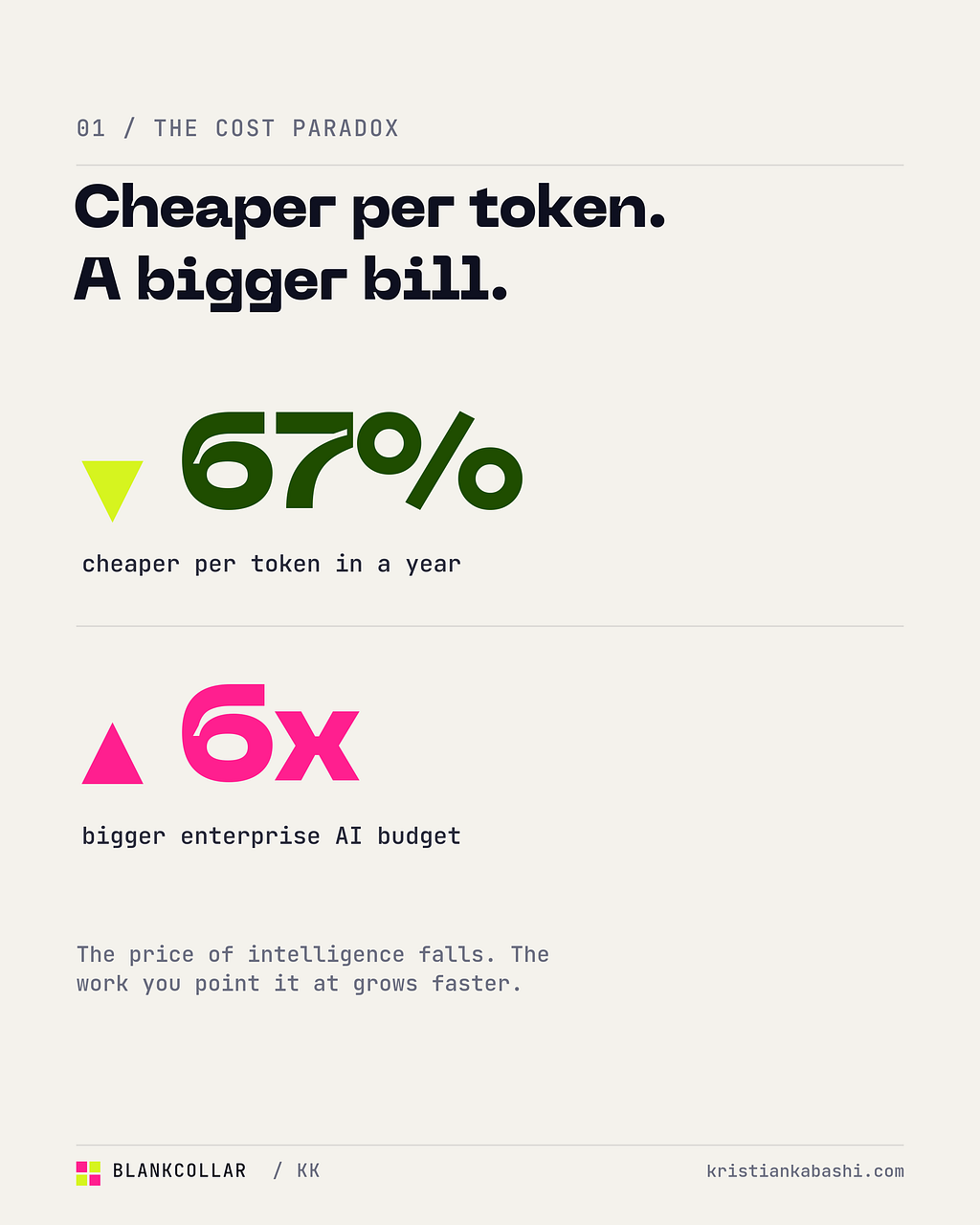
The unit price has collapsed. By industry estimates the blended cost of a million tokens fell roughly two thirds in a single year, and the cost of a given level of capability has dropped by something like ten times since early last year. And yet the average enterprise AI budget has gone from a bit over a million dollars two years ago to around seven million now, inference alone eats most of that, and most companies say their AI spend came in well over what they projected. The price of intelligence is in free fall and the bill keeps going up.
I write about this under a name I gave the idea, Blank Collar, and this particular paradox is one every executive is about to have to explain to a board.
The cost paradox, explained
The reason both things are true is simple once you see it. The price per unit is falling, but the number of units you consume per outcome is rising faster. Every time the models get cheaper and better, you point them at more work, you let agents run longer, you let them think harder, and consumption climbs faster than price drops. One forecast has agentic AI driving more than a twentyfold increase in token consumption by the end of the decade. A cheaper engine that you run a hundred times as often is not a saving. It is a bigger bill with a better story attached.
This is why budgeting AI like a software license is a mistake. A license is fixed. You buy a seat, you know the number. AI is not a license, it is a utility, and the meter runs faster the more useful it becomes. Microsoft’s own reporting has made the uncomfortable point that for some tasks, running the agent can cost more than paying a person to do the work. The companies that handle this well treat AI cost the way they treat cloud cost, as something you actively manage with real discipline, not a flat fee you forget about. The ones who do not are the ones writing the surprised memo to the board in two quarters.
The question under the cost question
Once you accept that this is a utility you will run at scale and forever, a deeper question surfaces, and it is the one this piece is really about. Where does it run, and who controls it. There are three answers, and they are the oldest question in infrastructure dressed in new clothes. You can rent, you can own, or you can do both.
Rent: the cloud you already use
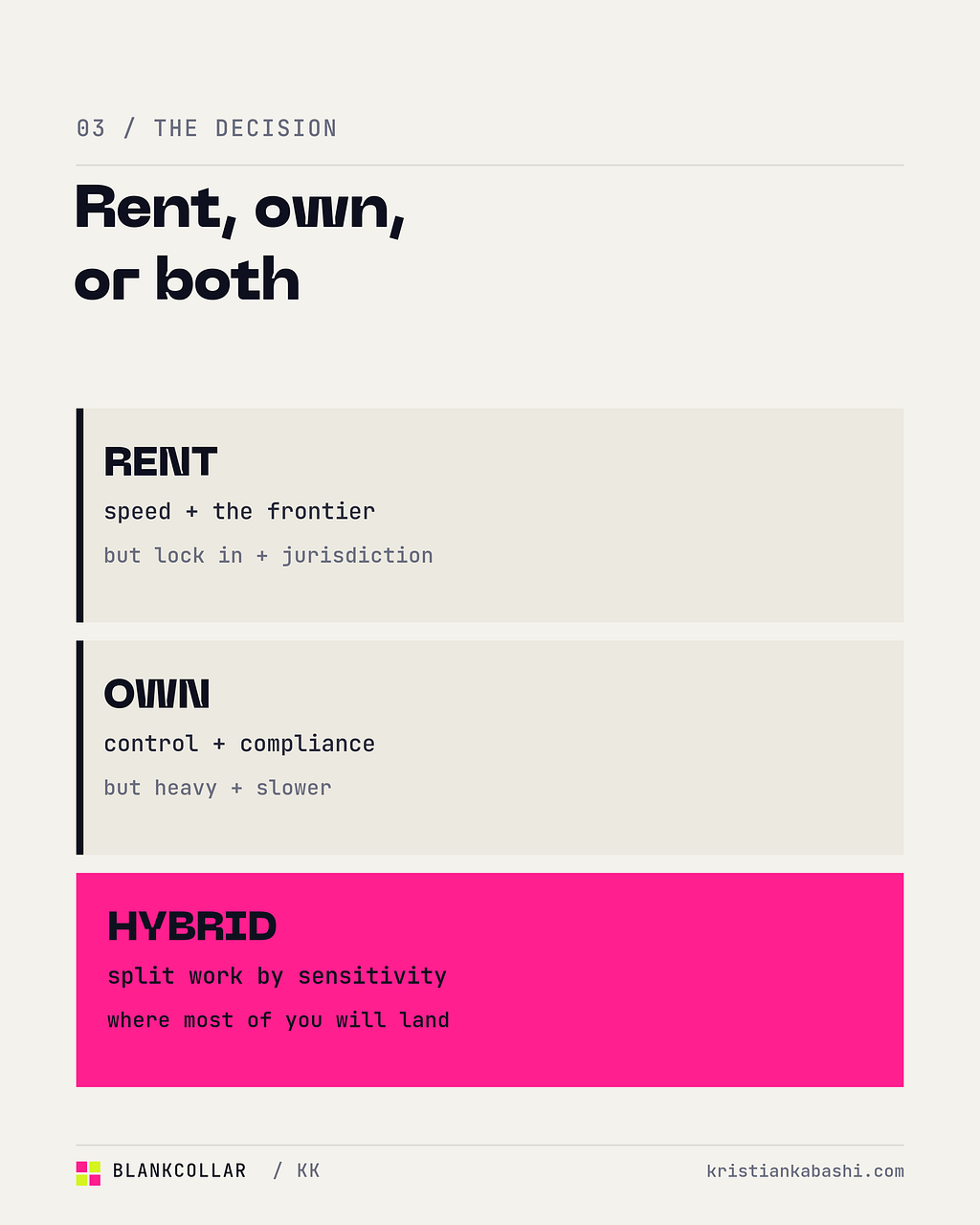
Renting means running your AI on the big cloud providers, the same hyperscalers you probably already live on. The case for it is strong and obvious. You get instant access to the frontier models, effectively unlimited scale, and none of the burden of building. For experimentation and for anything at the cutting edge, renting is simply correct. You should not be buying data centres to test an idea.
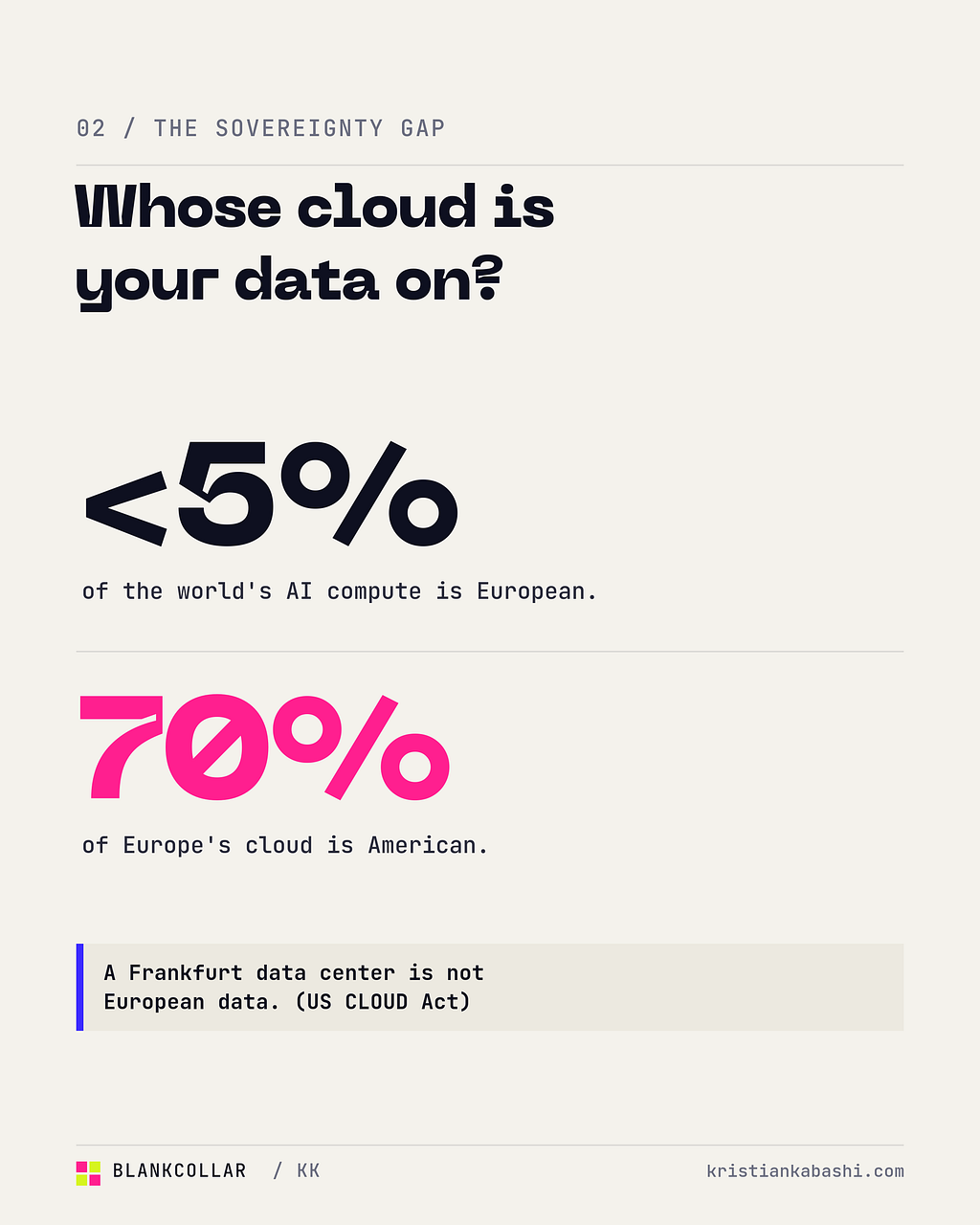
The case against it is quieter and slower to arrive, and it has two parts. The first is lock in and cost. When your whole operation runs on one provider’s models and one provider’s pricing, you do not really control your own bill or your own roadmap. The second is sovereignty, and this one has moved from a compliance footnote to a boardroom topic in the last year. Many European leaders assumed that data in a Frankfurt data centre was European data. It is not, legally. Under the US CLOUD Act, an American provider can be compelled to hand over data it holds anywhere in the world, which sits in direct tension with European law. This is not theoretical anymore. The European Commission put forward a Tech Sovereignty Package this year and is weighing real limits on using American clouds for sensitive sectors like health, finance and justice. If your most sensitive data and your core reasoning all run on someone else’s jurisdiction, that is now a strategic risk, not just an IT one.
Own: a sovereign stack
Owning means running AI on infrastructure you control, on open models you can host yourself, with your data never leaving your jurisdiction. The case for it is control, compliance by design, predictable economics once you are at real volume, and the simple fact that your knowledge and your reasoning stay yours. For a bank, a hospital, a defence supplier, or anyone whose data is the business, this is increasingly not optional.
The case against it is just as real. It is heavy. It needs capital, talent that is hard to hire, and a tolerance for moving slower than a credit card and an API. And the honest backdrop is that Europe is starting from behind, controlling less than five percent of the world’s AI compute while a handful of American providers hold around seventy percent of its cloud market. That gap is exactly why you are seeing a wave of sovereign building, from the EuroStack idea to Mistral financing its own data centres to national telecoms standing up industrial AI clouds. Owning is no longer a fantasy. But it is a serious commitment, not a default.
Hybrid: where most of you will actually land
The honest answer for almost every company is not one of the two extremes. It is both, on purpose. You split your work by how sensitive and how repetitive it is. The frontier experiments and the spiky, occasional, non sensitive workloads you rent, because speed and access matter more there. The sensitive data, the regulated processes, and the high volume work that runs constantly, you move toward infrastructure you control, because that is where both the risk and the runaway cost concentrate.
Two developments make this practical in a way it was not a couple of years ago. Open weight models are now good enough that you can run capable AI on your own hardware without giving up much, which means owning no longer means falling behind. And the market has clearly voted for not marrying anyone. The large majority of enterprises now run more than one model provider on purpose, so they can route each job to the right engine and never be hostage to a single vendor’s price or roadmap. The companies getting this right are building a layer that lets them move workloads between rented and owned as the economics and the rules change, which they will, constantly.
The actual decision
So do not start from cheapest. Start from a simple map. List your workloads, and for each one ask two questions. How sensitive is the data, and how often will this run. The sensitive and constant work earns the investment of owning it. The experimental and occasional work belongs on rented frontier infrastructure. And whatever you choose, refuse to wire yourself so tightly to one model or one cloud that you cannot move, because the single safest prediction in this entire field is that the cheapest, best, and most compliant option will be different in a year than it is today.
The goal was never to spend the least. The goal is control, predictable economics, and the freedom to change your mind as the ground shifts, in a market that reprices itself every few months. Rent what you should rent. Own what you should own. And keep the door open, because you will need it.
Work is for bots. Deciding whose machines the bots run on, and who can reach your data through them, is for you.
Kristian Kabashi writes Blank Collar, a field guide for executives rethinking how their companies are built. More at kristiankabashi.com.
Sources: Fortune, Microsoft and the real cost of AI · Goldman Sachs, AI agents and token consumption · Euronews, Europe builds sovereign cloud and AI · CNBC, EU weighs restricting US cloud for sensitive data