Agents, skills, tools, MCPs and the CLI, in plain English, for people who run companies instead of writing code.
By Kristian Kabashi
Every week, somewhere, an executive sits in a meeting and nods along while a younger colleague says something like “we wired an MCP server so the agent can use these tools and load that skill, and it runs in the CLI.” Everyone nods. Nobody asks. And the meeting moves on while half the room quietly has no idea what just got decided.
That is not your fault. The people building this stuff talk to each other, not to you. The whole field is described in a private language, and almost nobody has bothered to translate it for the people who actually sign the cheques. So let me do that, using one analogy you already understand completely, because you have done it a hundred times. Hiring.
I write about this under a name I gave the idea, Blank Collar, and here is the entire AI stack as if you were building a team.
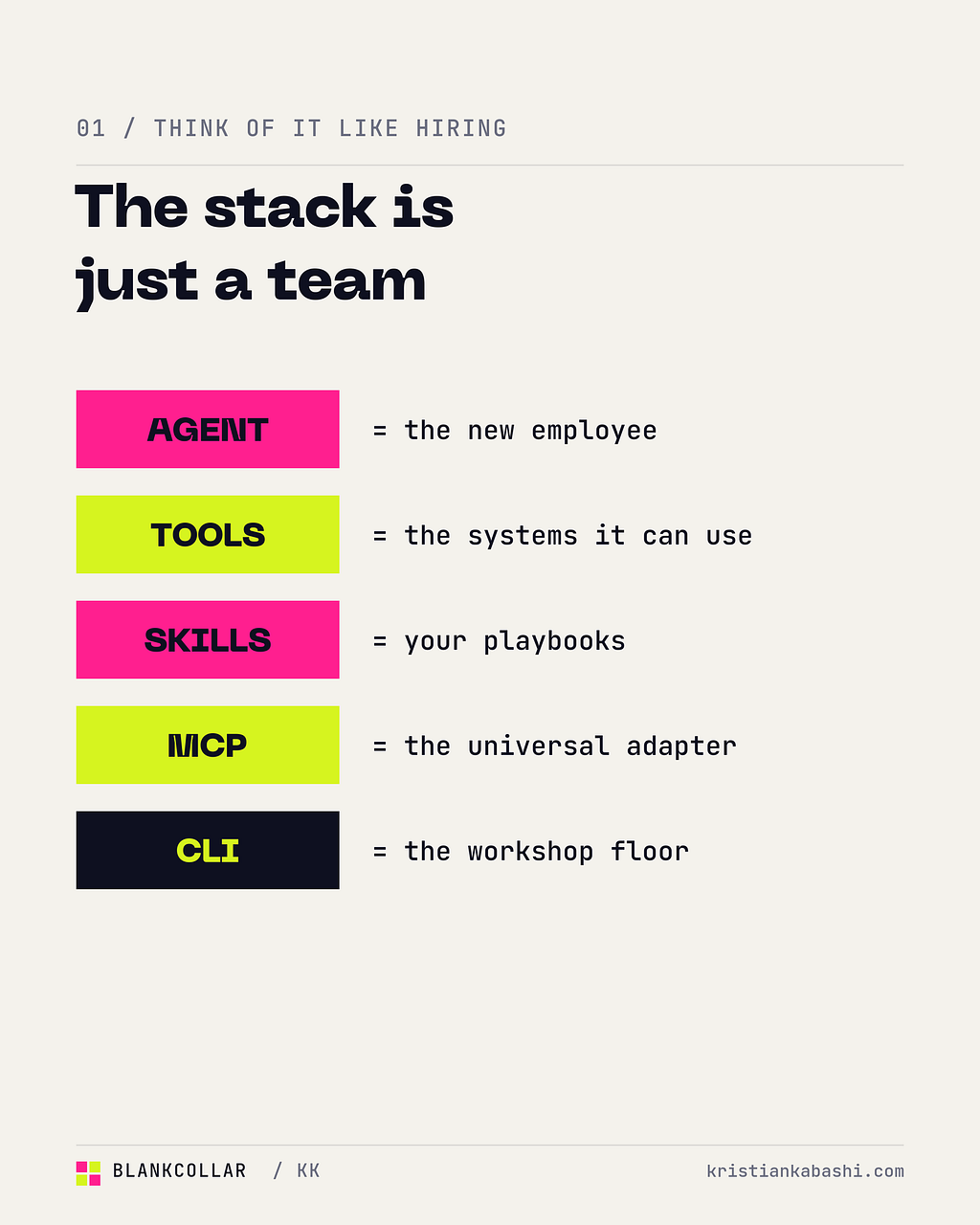
An agent is an employee
Start with the word everyone uses and nobody defines. An agent is not a chatbot. A chatbot answers. An agent acts. You give it a goal, and it works out the steps and carries them out, checking its own progress along the way. The difference between the chatbot you used in 2023 and the agent you are hearing about now is the difference between an assistant who tells you how to file the report and one who actually files it.
So treat an agent as a new hire. A capable, fast, tireless employee who shows up knowing a great deal about the world in general and nothing about your company in particular. Everything else in the stack exists to turn that raw new hire into someone genuinely useful to you.
Tools are the things they are allowed to use
A brilliant new hire with no access to anything is useless. They cannot send the email, open the system, or run the numbers, because they have no accounts and no permissions. Tools are how you fix that.
A tool, in this world, is any specific action an agent is allowed to take in the real world. Send an email. Query a database. Pull a report. Run a calculation. Post to a channel. Each one is a tool, and an agent can only do what its tools let it do. An agent with no tools is an intern who can think beautifully and touch nothing. An agent with the right tools is an operator. When someone says they are “giving the agent tools,” they mean they are handing your new hire the keys to specific systems, one carefully chosen door at a time.
Skills are your playbooks
Here is the part most people miss, and it is the part that actually makes AI work inside a real company. A smart hire still does things the generic way until you teach them your way. Skills are how you teach them.
A skill is a packaged playbook. The standard operating procedure for how a particular job gets done here, written down once so the agent follows it every time. How your board pack is structured. How you qualify a lead. The exact tone of your customer replies. Instead of explaining it again on every task, you hand the agent the skill, and it does the job your way, consistently. Skills are the onboarding documents that turn a clever stranger into someone who works like they have been at your company for years. The companies pulling ahead are the ones quietly building a library of these, because a skill written once pays off on every task forever.
MCP is the universal adapter
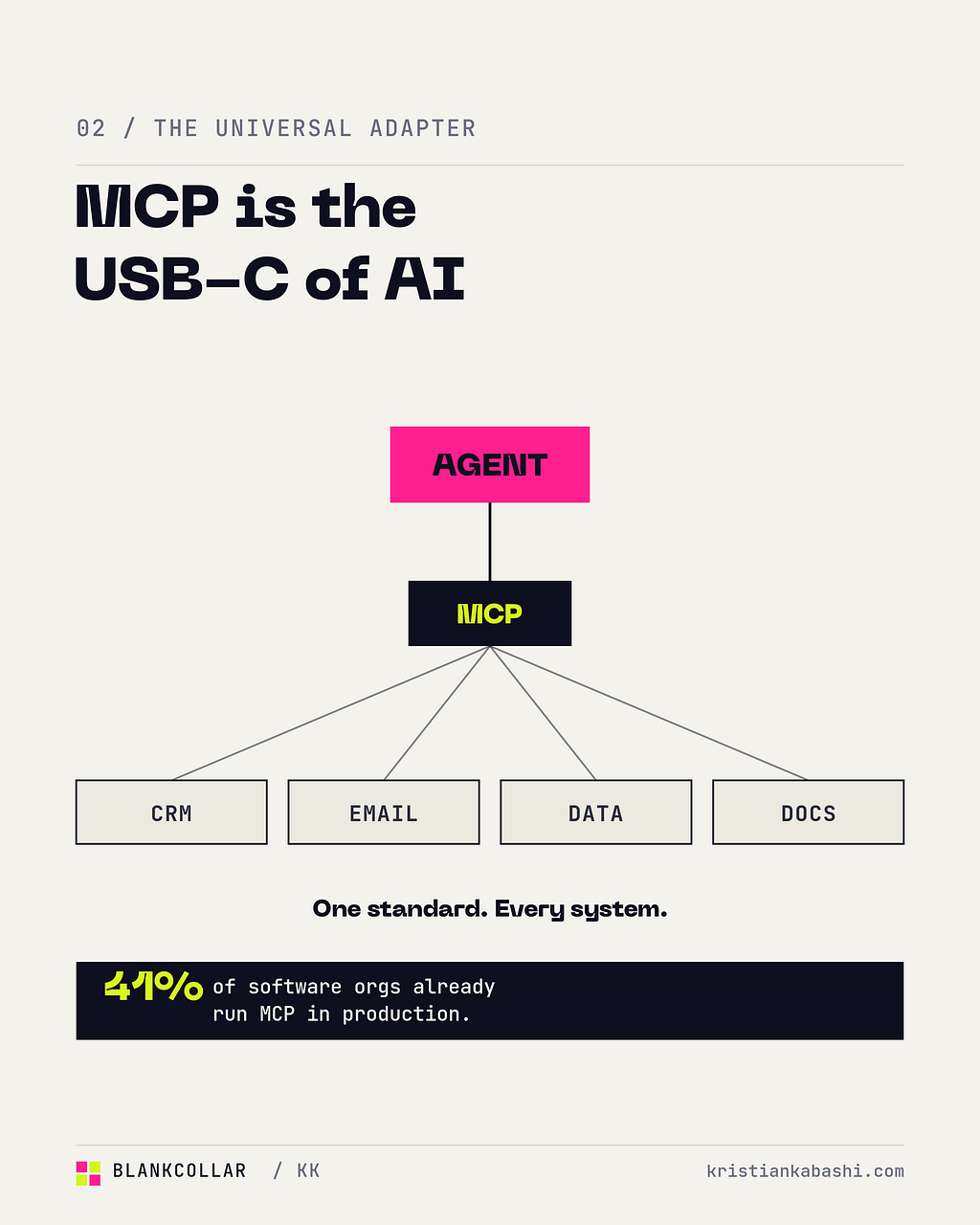
Now the acronym that makes everyone’s eyes glaze. MCP stands for Model Context Protocol, and you can forget the words entirely if you remember one image. It is the USB-C of AI.
Before MCP, every single connection between an agent and one of your systems had to be hand built, custom wiring for every door, expensive to make and quick to break. MCP is a single open standard that replaced all of that. It is the universal plug that lets any agent connect to any system the way a USB-C cable connects to almost anything, without a bespoke adapter for each one. That is the whole point, and it is why this one boring acronym matters more than most of the flashy stuff. It turned a hundred custom integrations into one common standard. This is not a fringe idea, either. By 2026 something like four in ten software organisations were already running MCP in production, and every major AI lab, the ones behind the models you have heard of, had adopted it.
The CLI is the workshop floor
Last one. The CLI, or command line, is the plain text screen with no buttons that you have seen developers type into and assumed was witchcraft. It is simply the engine room. The workshop floor behind the polished showroom of an app.
Here is why it matters to you even though you will likely never touch it. Apps are built for humans, with menus and clicks, which is friendly but slow. The command line is built for raw power and speed, which is exactly what an agent wants. So when your agents do real, heavy work, they often do it down in the CLI, because it is faster and stronger than clicking through a screen. You do not need to live there. You just need to know it exists, that it is where the heavy lifting happens, and that “it runs in the CLI” means “it works in the engine room, not the showroom.”
That is the whole stack
Put it together and the private language dissolves. You hire an agent. You give it tools, the systems it is allowed to use. You hand it skills, your playbooks for how work gets done here. You let it plug into everything through MCP, the universal adapter. And it does its heavy lifting in the CLI, the workshop floor. Everything else you will hear is a detail hanging off one of those five hooks.
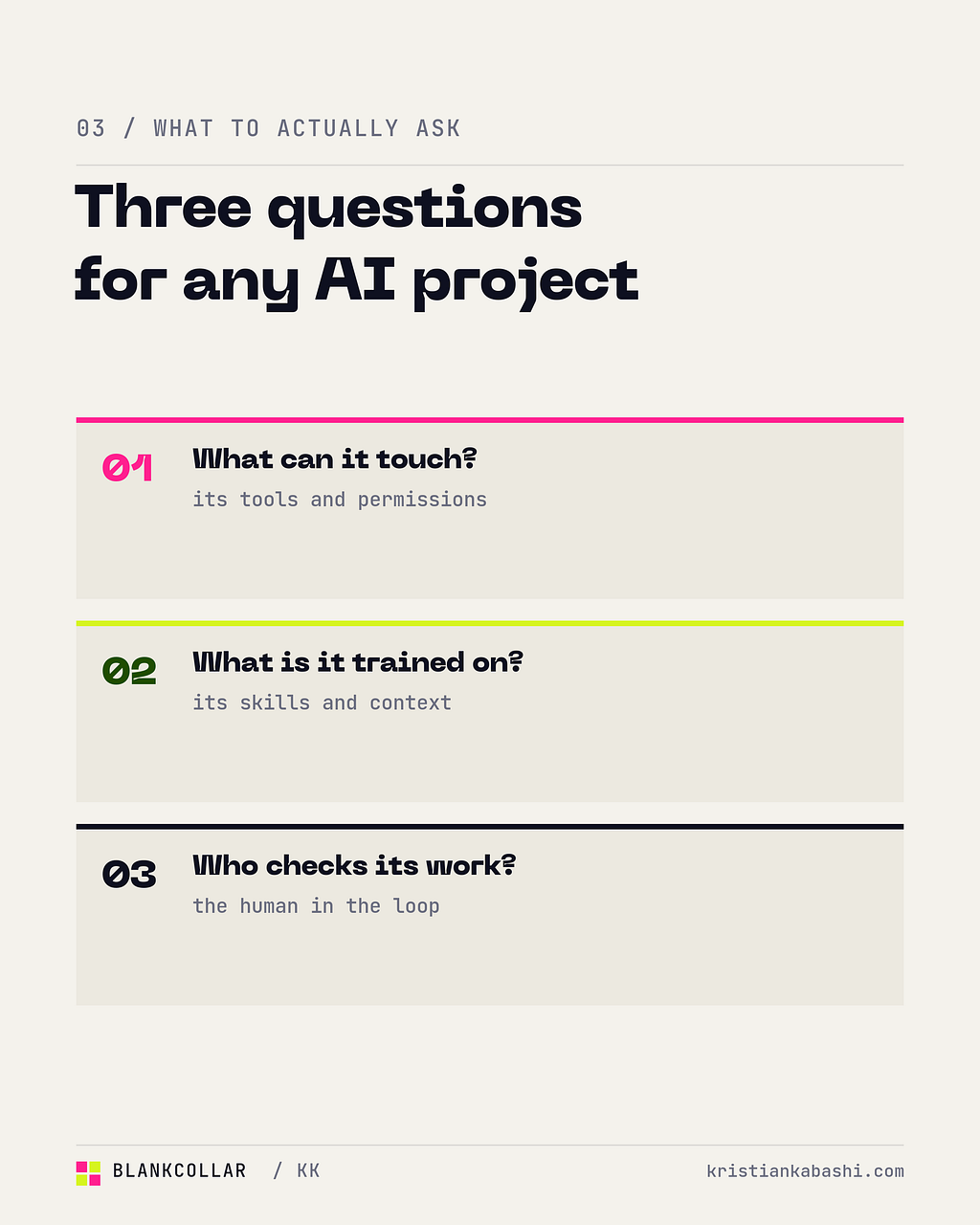
You do not need to build any of this. You need to recognise it, because the moment you can read the map, you can ask the three questions that actually matter when someone proposes an AI project. What can it touch. What is it trained on. And who checks its work. Ask those three and you will sound like the sharpest person in the room, which, on this topic, you now are.
Which raises the real question, and it is not about the technology at all. It is about you. What does it take to become the person who directs all of this, instead of the person it quietly replaces. That is the next field guide.
Kristian Kabashi writes Blank Collar, a field guide for executives rethinking how their companies are built. More at kristiankabashi.com.
Sources: Anthropic, introducing the Model Context Protocol · The 2026 MCP roadmap · 2026, the year for enterprise-ready MCP adoption (CData)