A field guide to the human side of AI transformation, including the decisions nobody wants to make.
By Kristian Kabashi
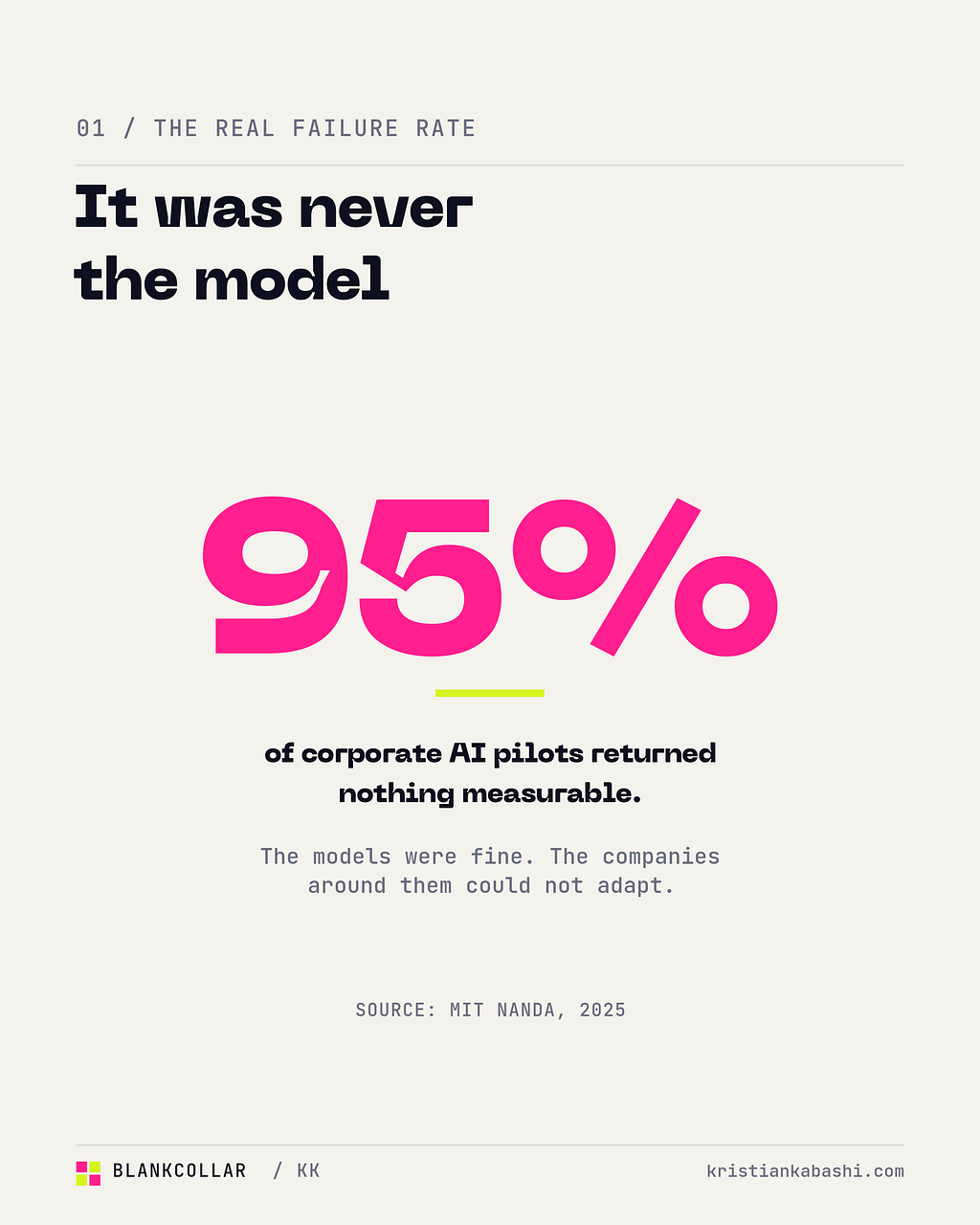
Every leader I talk to about AI starts in the same place, asking which tools to buy and which model to standardise on. It is the wrong first question, and you can prove it with one number. A widely cited MIT study this past year found that ninety five percent of corporate AI pilots produced no measurable return. The researchers were clear about why, and it had almost nothing to do with the technology. The models were fine. What failed was the organisation around them, the workflows, the structures, the people who were never brought along. They called it a learning gap. I would call it the whole game.
The technology is the easy part now. It is bought in an afternoon. The hard part is the part it has always been, which is people. This is a field guide to that part, and it does not flinch from the section most articles skip, which is what you do about the people who cannot or will not make the move.
I write about this under a name I gave the idea, Blank Collar, and I want to be honest about it from the start, because honesty turns out to be the entire technique.
Your people are already ahead of you
Start by killing a comfortable myth, the one where leadership is racing forward and a frightened workforce is dragging its feet. The data says the opposite. That same body of research found that while only about forty percent of companies had bought official AI subscriptions, ninety percent of workers were already using personal AI tools to get their jobs done. There is a shadow AI economy running inside your company right now, whether you sanctioned it or not. Your people did not wait for permission. They are ahead of you.
So the resistance you are bracing for is mostly not where you think. It is rarely the frontline person who quietly automated half their week. More often it is the layer of management whose status was built on controlling information and assigning tasks, the exact work a model now does. That is worth knowing before you start, because you will aim your change effort at the wrong people if you assume fear lives at the bottom.
Why change keeps failing
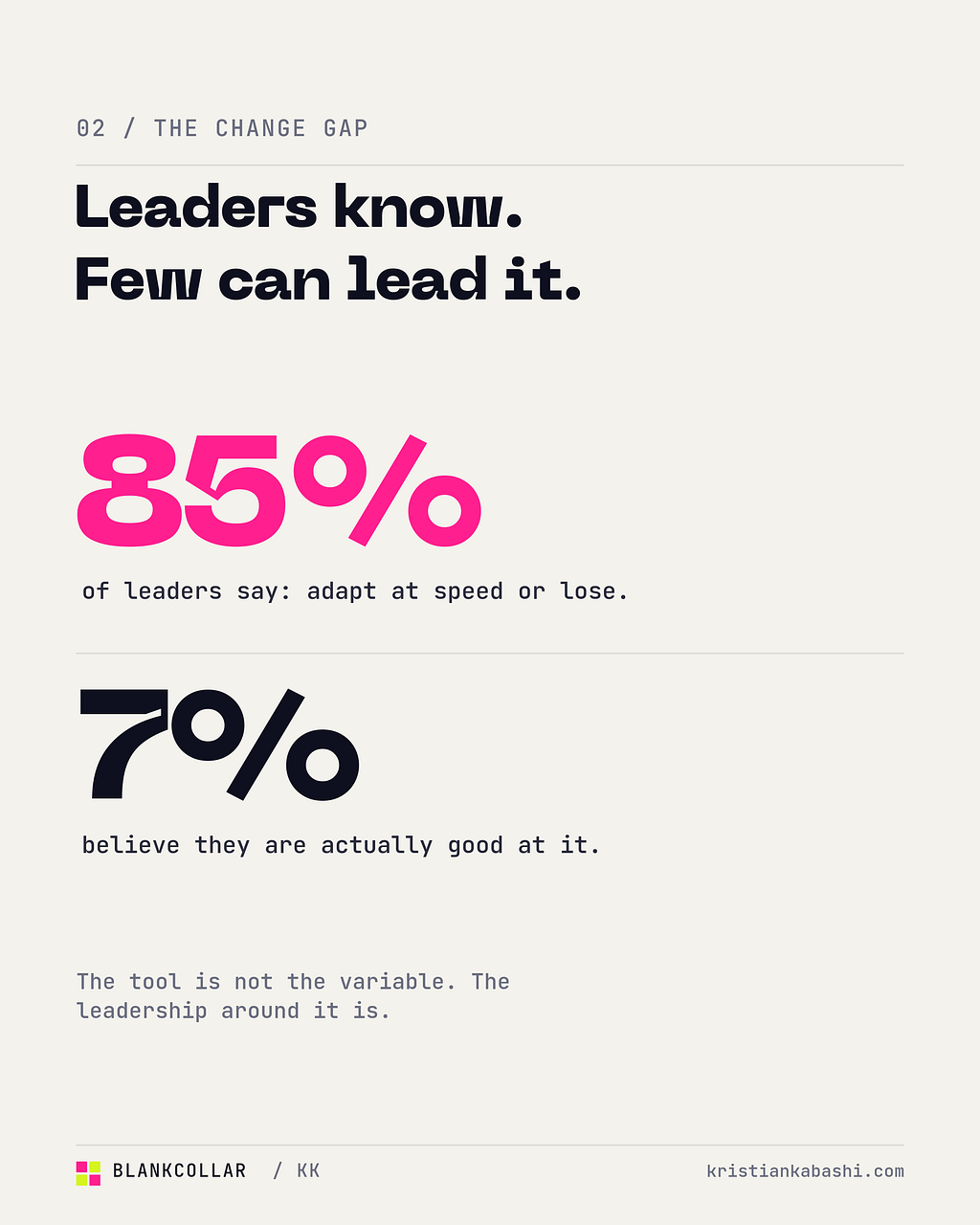
There is a second set of numbers that should stop any executive cold. In recent workforce research, eighty five percent of leaders said the ability to adapt at speed was critical, and only seven percent believed they were actually good at leading it. Ask employees and only about a quarter think their organisation manages change well, and many report living through more than a dozen significant changes in a single year.
That is the real terrain. Not a workforce that hates AI, but a workforce that is exhausted by change badly done and led by people who privately admit they are not good at leading it. Drop a powerful new tool into that and the tool is not the variable that decides the outcome. The quality of the leadership around it is.
How you actually bring people along
The instinct under pressure is to reassure. To send the email that says nobody has anything to worry about and everything will be fine. It is the worst thing you can do, because everyone can see it is not entirely true, and the moment they catch you softening reality, you lose them. They stop believing the next thing you say.
The technique that works is the opposite, and it is uncomfortable. Tell people the truth, clearly. The truth is that the dull parts of their jobs are going to move to machines, that this is not optional, and that the plan is to ask more of them, not less, not to quietly thin them out. People can carry a hard truth told straight. What they cannot carry is a vague reassurance they can see through.
Then show instead of mandate. Rebuild one real workflow with one willing team, let the rest of the company watch that team get their week back, and let the pull do the work that a policy never could. Make AI fluency a baseline expectation, the way literacy is, and actually invest in it rather than announcing it. And redeploy the time you free up on purpose, toward customers and craft and the bets you never had capacity for, so that becoming more efficient visibly leads to better work rather than to a smaller team. People watch what happens to the first hours that get freed. If those hours turn into more interesting work, you have a movement. If they turn into a layoff, you have a war.
The decision nobody wants to make
Now the part most people will not write down. Not everyone makes the shift, and pretending otherwise is its own kind of cowardice. Some people cannot adapt to the new way of working, and some simply will not. Leading this honestly means being just as clear about that as about everything else.
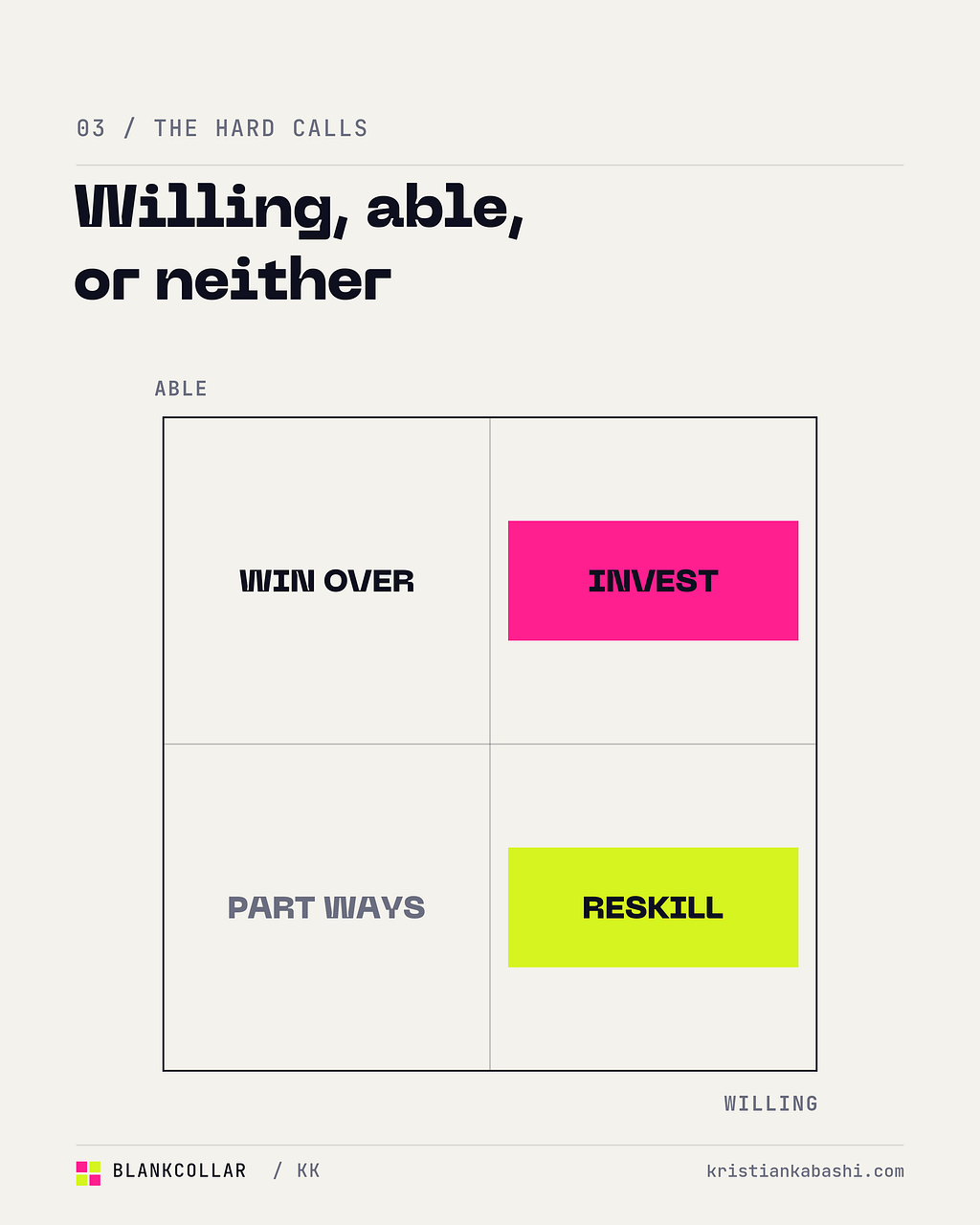
I find it useful to sort people on two axes, willing and able. Are they willing to work in the new way, and are they able to.
The ones who are willing and able are your foundation. Give them room, give them the best tools, and get out of their way. The ones who are willing but not yet able are your biggest opportunity, and they are who reskilling is actually for. Invest in them seriously, because their loyalty is worth more than their current gap is costly. The ones who are able but not willing are a leadership problem, not a training problem. Find out what is really behind the refusal, win them over if you can, and accept that some of them have decided this is not the company for them.
And then there is the last group, the people who are neither willing nor able, after you have genuinely given them the tools and the time and the honesty. Keeping them is not kindness. It is a slow unkindness to them, who can feel they no longer fit, and a real unfairness to the people next to them carrying the difference. The humane thing, done with dignity and a fair package and straight talk, is to help them move on. Clarity is the most respectful thing you can offer someone whose role has genuinely changed out from under them. Dressing it up helps no one.
This is not a story about fewer people
None of this is a case for gutting your headcount, and the broader evidence does not support that story anyway. The World Economic Forum projects that this wave reshapes far more jobs than it eliminates, with tens of millions of roles created on net even as many are displaced. The Boston Consulting Group reached a similar conclusion, that AI will reshape more jobs than it replaces. The work is not disappearing. It is changing shape, and your job is to move your people into the new shape, deliberately, and to be honest with the few who will not move.
That is the real work of leading this change, and it is harder than any procurement decision. The model selection is a Tuesday. Looking a long serving employee in the eye and telling them the truth about where their role is going is the actual job. The companies that come through this well will not be the ones with the best technology. Everyone will have the same technology. They will be the ones whose leaders were brave and honest with their people while the ground moved.
Work is for bots. The hard, human, unglamorous business of bringing people with you, and being straight with the ones you cannot, is for you. That was always the job.
Kristian Kabashi writes Blank Collar, a field guide for executives rethinking how their companies are built. More at kristiankabashi.com.
Sources: MIT NANDA via Fortune, 95% of GenAI pilots failing · World Economic Forum, Future of Jobs · BCG, AI will reshape more jobs than it replaces · Gloat, AI workforce trends 2026