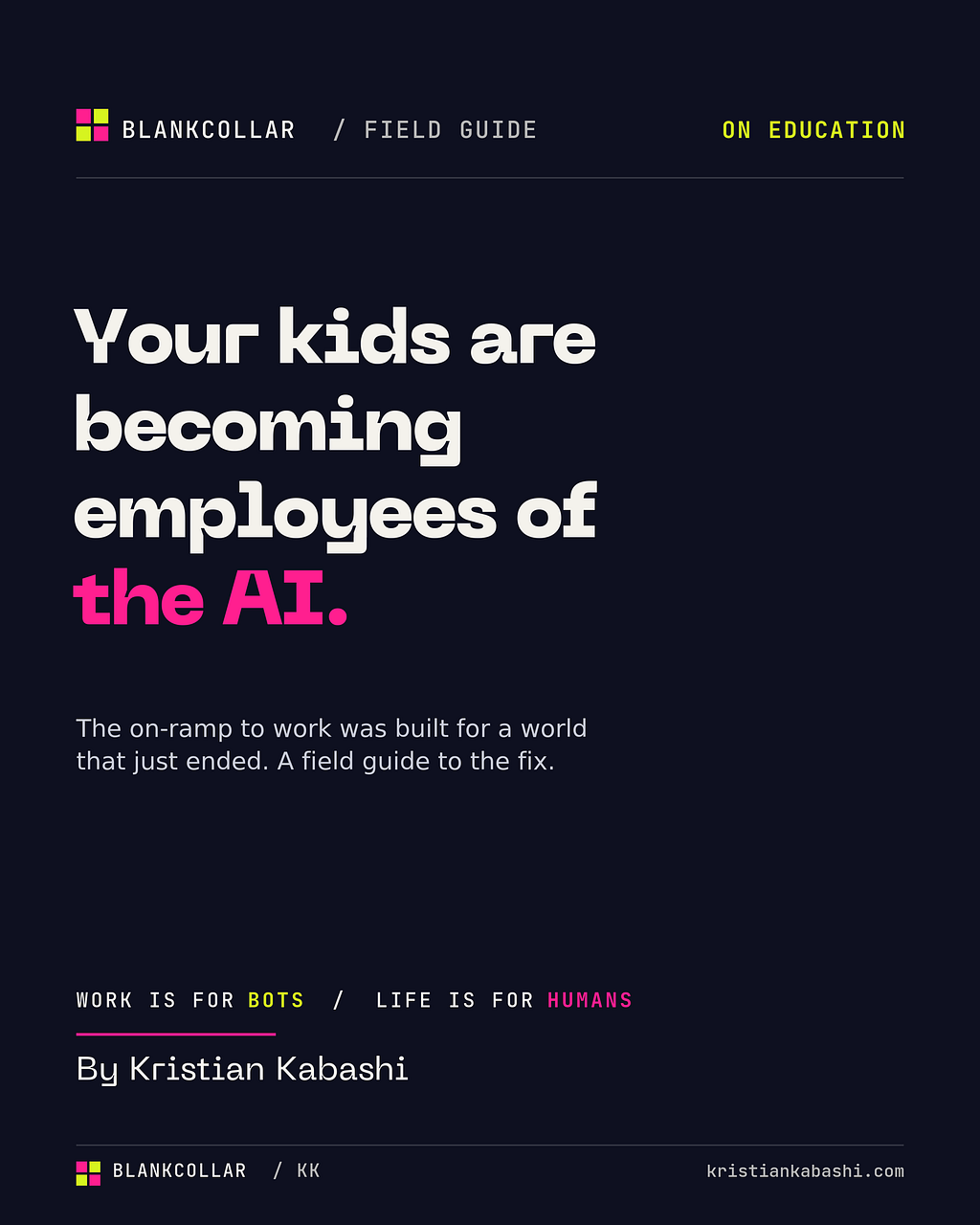
And so are most of us. The schools, the degrees, the whole on-ramp to work were built for a world that has quietly ended. A field guide to fixing it before the gap becomes permanent.
By Kristian Kabashi
Here is the thing I cannot stop turning over. We built AI to work for us, and somewhere in the last two years we started training our kids, and a lot of our employees, to work for it. They ask the machine what to do. They take what it gives them. They hand it in. The human has become the junior, and the model has become the boss, and almost nobody decided this on purpose. It just happened, the way these things do, one convenient shortcut at a time.
I want to be careful here, because this is easy to turn into a doom sermon and I do not think it is one. The tools are extraordinary. The problem is the on-ramp. The system we use to turn a sixteen year old into a capable adult who can earn a living was designed for a world where knowing things was scarce and valuable. That world is mostly gone. Intelligence got cheap and abundant more or less overnight, and we are still running an education model built to ration it. So this is a field guide for the parents, students, employees and leaders who can feel that something is off but have not quite been told what. We are late. Let me try to make the case anyway.
The on-ramp collapsed
Start with the part that is not theoretical, because it is already showing up in the data. The bottom rung of the career ladder, the entry-level job where you used to learn the trade, is being sawn off.
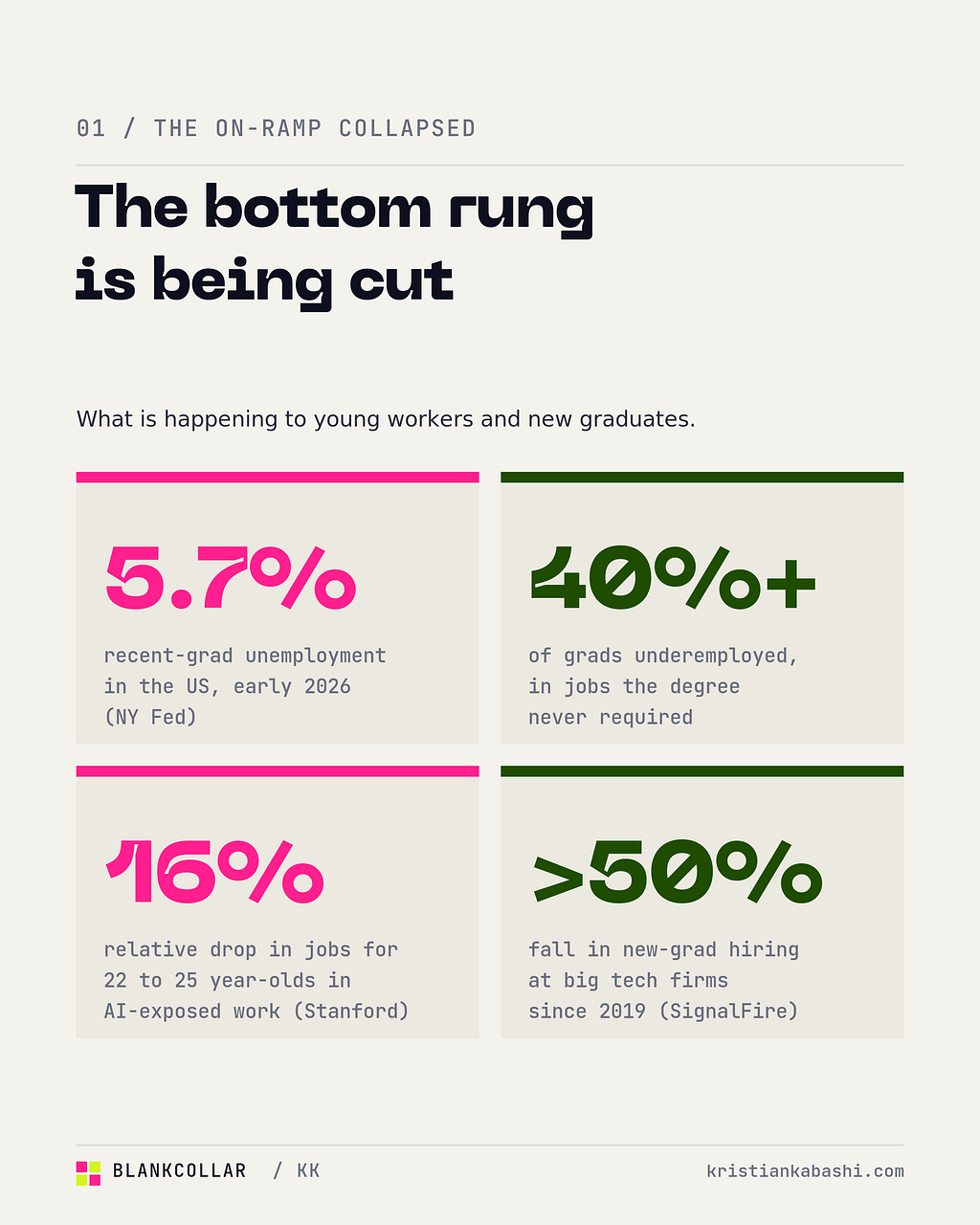
In the United States, the unemployment rate for recent college graduates sat around 5.7 percent at the start of 2026, and underemployment, meaning grads working in jobs that never required the degree, was running north of 40 percent. The number that should worry you more is the trend. Since late 2022, unemployment for new graduates has risen faster than for the workforce as a whole. For the first time in a long time, having the degree and being young is a disadvantage in the data, not an edge.
Then there is the AI-shaped fingerprint on top of that. A Stanford team led by Erik Brynjolfsson looked at payroll records and found that workers aged 22 to 25 in the jobs most exposed to generative AI had seen roughly a 16 percent relative drop in employment since the tools went mainstream, while older, more experienced people in the very same jobs held steady or kept growing. The Burning Glass Institute put a name to the shape of it. They call it the flipped pyramid. AI is good at exactly the work juniors used to cut their teeth on, the research, the first draft, the basic analysis, the routine note. So the stepping stones are dissolving, and over half of recent graduates end up a year out in jobs they did not need college for. At the big technology firms, new-graduate hiring is down by more than half from where it was in 2019.
I will be honest about the argument here, because the house style is to not oversell. Not everyone agrees AI is the main cause. The Yale Budget Lab looked in late 2025 and found no dramatic shift in the job mix yet. A lot of serious people think the bigger driver is the end of cheap money and the hiring binge that came before it, with AI acting as an accelerant rather than the root. That is fair. But the direction is not really in dispute, and Dario Amodei, who runs Anthropic and has every reason to be optimistic about AI, said out loud in 2025 that he would not be surprised to see big effects on entry-level white-collar work within one to five years. When the person selling the technology is warning you about this, it is worth a pause.
The diploma turned into a black box
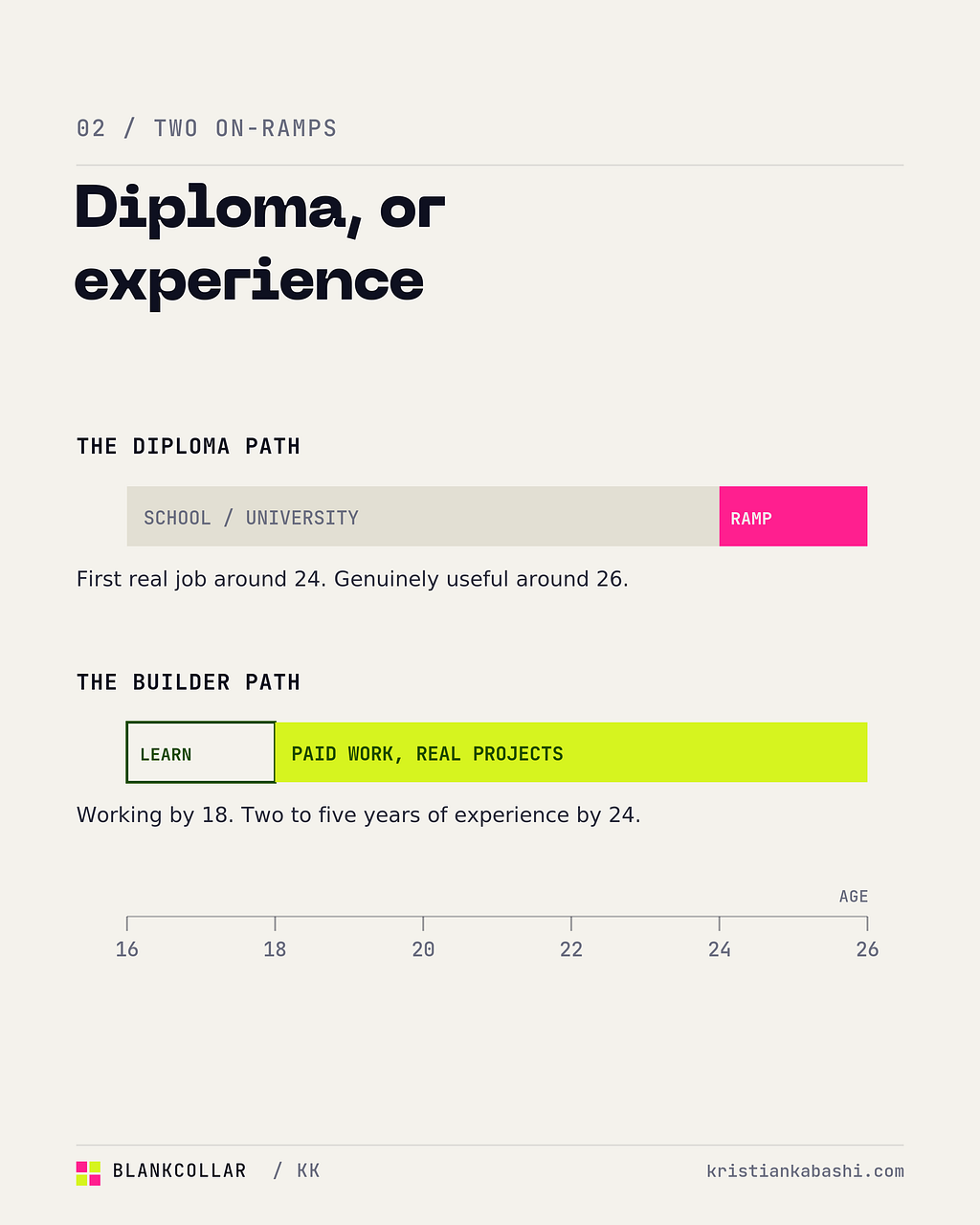
Now the part that is closer to home, and that you already suspect if you have hired anyone recently. A new graduate today often arrives as a sealed box. Four to six years went in. What comes out is a transcript and a person who, in most cases, needs another year or two of company time before they are genuinely useful. They finish at 22 to 24, ramp until 25 or 26, and that is the good outcome, the one where they found a job that fits the diploma at all.
Meanwhile there is a quieter group who never went the standard route. They learned from YouTube, from online courses, from building things badly and then less badly, and now from AI itself. Some of them were in real jobs at 18. By the time their peers are walking across a stage, they have two to five years of actual work behind them. Not a transcript. Work. I keep meeting these people, and the gap between what they can do and what a fresh graduate can do is often embarrassing for everyone involved.
The market has started to notice. Skills-based hiring went from something HR talked about to something companies actually do, with surveys showing the share of US firms hiring on demonstrated skill rather than the degree climbing from around half a few years ago to roughly four in five now. IBM dropped the degree requirement on about half its US roles. More than twenty US states have done the same for government jobs. In the UK, apprenticeship completers end up in full-time work at noticeably higher rates than university graduates. The credential used to be a cheap signal that someone was probably capable. That signal is getting noisy, and employers can feel it.
Everyone has an Einstein in their pocket
So step back and ask the obvious question that almost nobody in education wants to sit with. If every person now carries a device that can explain almost anything, in any language, at any level, patiently, for roughly the price of nothing, why is the core activity of school still pushing facts into heads so they can be recalled on a test?
That model made sense for a long time. Knowledge was genuinely hard to get to. A person who had memorised a great deal, and could retrieve it on command, was valuable, so we built an entire system to mass-produce that person. The factory ran for a century and it worked. The trouble is that the product it makes, a reliable knowledge-recall worker, is the exact thing that just lost most of its market value. We are still optimising kids to win a competition the machines have already won.
This is the heart of it for me. The point of learning was never really the facts. It was what the facts let you do, which is think. Reason about something you have not seen before. Hold an abstract idea in your head and turn it around. Tell good from almost-good. Those did not get less valuable. They got more valuable, because they are now the rare part. We just have an education system pointed at the wrong target.
Start the blank collar much earlier
Here is where I land on the fix, and it is not a futuristic one. Parts of it have been running quietly in the German-speaking world for decades. The dual system.
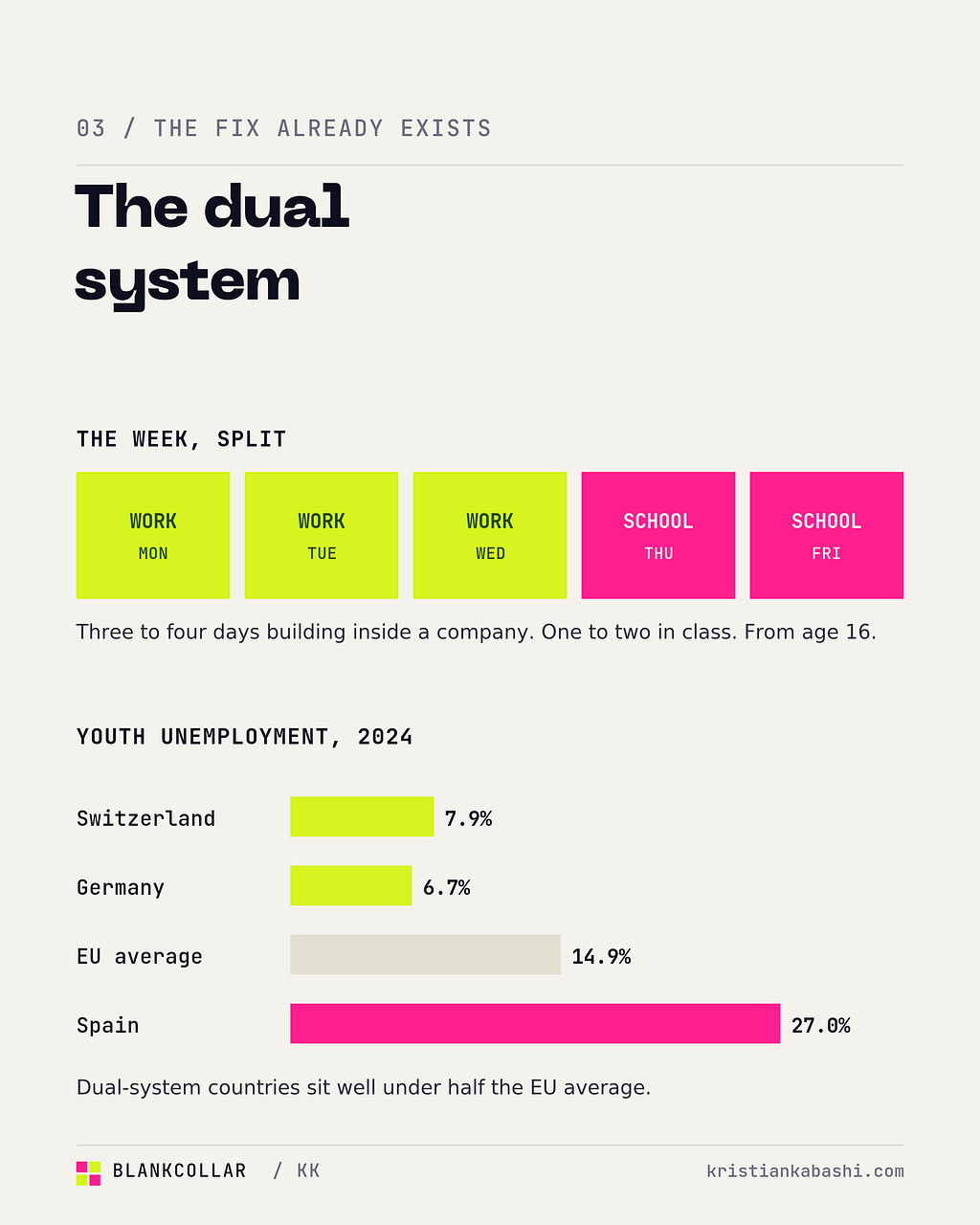
In Switzerland, where I live, roughly two-thirds of young people do not go straight to university at all. At about fifteen or sixteen they enter vocational training that splits the week in two. Three or four days inside a real company, doing real work, getting paid, and one or two days in school learning the theory that the work makes concrete. They finish around eighteen or nineteen with a recognised qualification, a few years of genuine experience, and a professional network, while their academic-track peers in other countries are still two or three years from their first real job. Germany runs a version of the same thing at large scale. And the outcome that everyone points to is youth unemployment. Switzerland and Germany sit among the lowest in the developed world, well under half the European Union average, while countries with the most purely academic systems often have the highest.
I am not romanticising it. Tracking a child onto a path at fifteen has real risks, and the honest critics are right that it can lock in disadvantage if you do it carelessly. The fix is not to copy the old apprenticeship model exactly. It is to take its core insight, that you learn a thing by doing it under guidance while you also study it, and aim that at the skills that now matter. Imagine a sixteen year old spending part of the week building real projects with AI tools inside a working team, and part of the week learning to think, to write, to reason, to judge. That is how you make a blank collar, someone who directs the machines rather than competing with them. And there is no good reason it has to wait until 22.
A degree is no longer a finish line
The deeper shift is that the whole idea of front-loading education into your first two decades and then coasting is finished, and not only for students. It is finished for everyone already working.
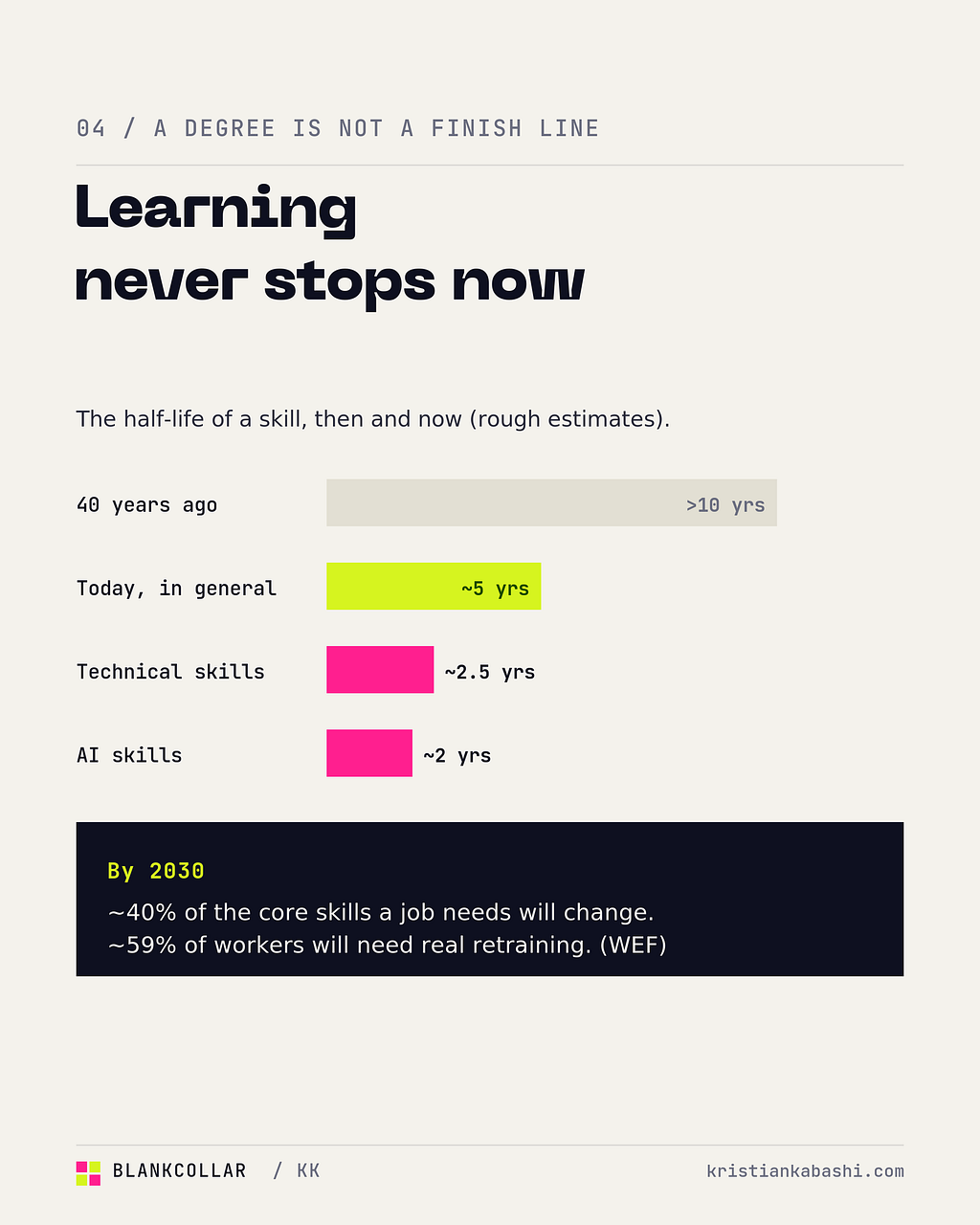
The numbers people use for the half-life of a skill are estimates, so take them loosely, but the direction is brutal. Forty years ago a skill might stay current for more than a decade. The common figures now are around five years for skills in general, closer to two or three for technical ones, and people who work in AI will tell you it can feel like two. The World Economic Forum reckons something like 40 percent of the core skills a job needs will shift by 2030, and that nearly six in ten workers will need real retraining in that window. A diploma earned at 23 and never topped up is a depreciating asset, and the depreciation is speeding up.
Which means university is not an event anymore. It is a habit you keep for life. And the responsibility does not sit only with the individual. Employers who want capable people in three years have to build the training in-house, the way Amazon committed over a billion dollars to retraining its workforce and Accenture put a billion into learning programs. The companies that treat education as something that happened to their staff before they arrived are going to wake up with a workforce that is quietly out of date. An internal curriculum is becoming as basic as having a payroll.
The attention problem, which is the hard part
I have been making this sound like a matter of will, as if we could simply decide to learn more and it would happen. It is not that simple, and pretending otherwise would be dishonest. Our ability to do the deep, sustained thinking this future demands is, frankly, in rough shape.
Gloria Mark at UC Irvine has measured how long people hold their attention on a screen before switching, and it fell from about two and a half minutes in 2004 to roughly 47 seconds by the mid 2010s. (You have probably heard that human attention is now shorter than a goldfish’s. That one is a myth, traceable to a marketing slide with no real study under it, and I mention it only because the truth is interesting enough without the fish.) Social media did the first wave of damage to our focus over the last decade. AI now risks doing a second wave, and a subtler one.
The early evidence is uncomfortable. An MIT Media Lab team wired people up while they wrote essays, some with ChatGPT and some without. The AI-assisted writers showed measurably lower brain engagement, and when asked afterward, most of them could not quote a single line of the thing they had just produced. The researchers called it cognitive debt. Separate work has linked heavier reliance on AI tools to weaker critical thinking, with the effect strongest in the youngest users, the 17 to 25 group who are forming these habits right as the habits matter most. These studies are early and some are correlational, so I would not bang the table with them. But the worry is plausible and worth taking seriously. If you let the machine do the thinking, the thinking muscle gets weaker, the same way it would if someone carried you everywhere and your legs forgot how to walk. Learning matters as much as it ever did. Maybe more.
Sparring partner, or boss
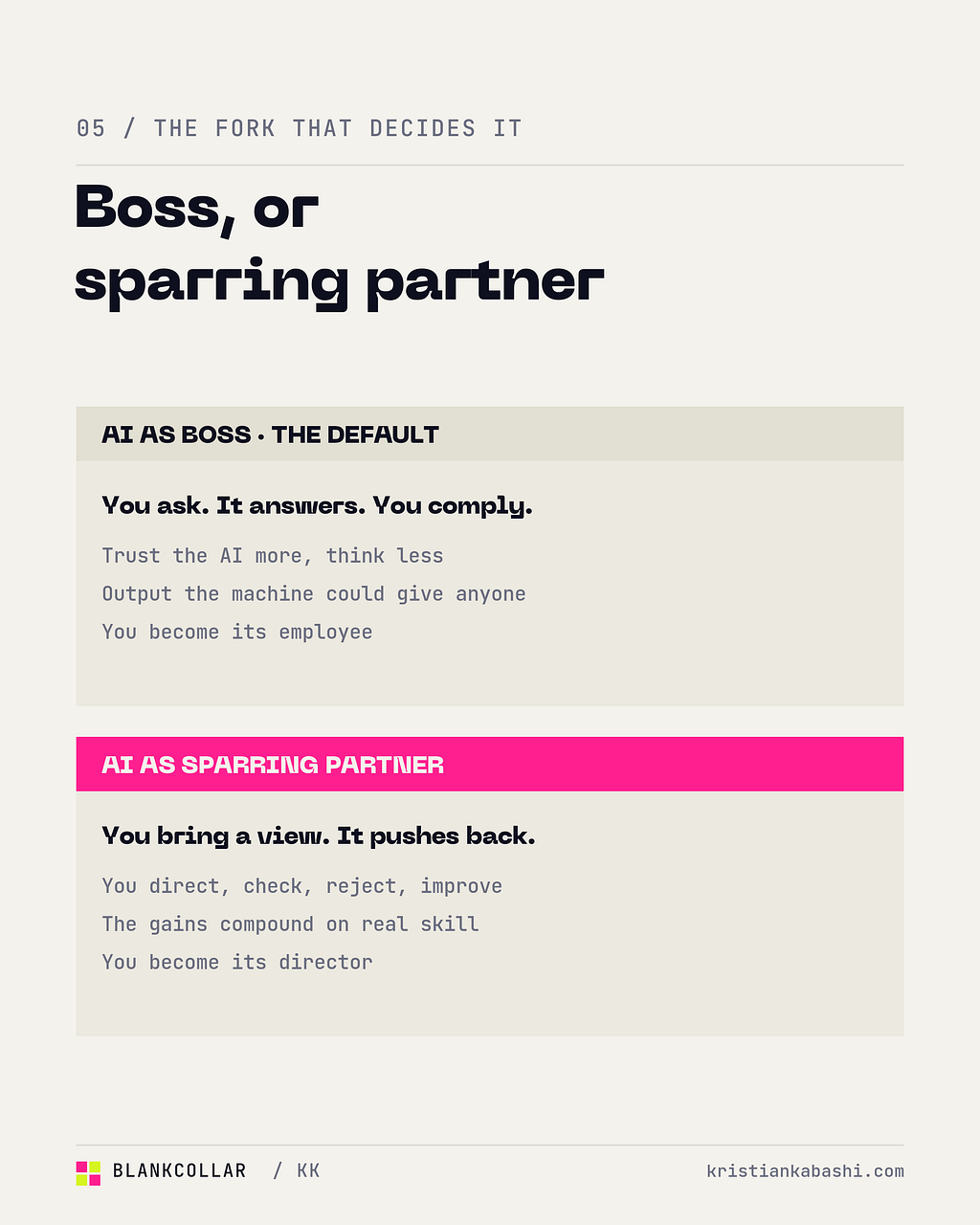
So everything comes down to one fork, and it is the most important thing in this whole piece. The same AI, used two different ways, produces opposite human beings.
Used one way, it is a boss. You ask, it answers, you comply. You become a clerk for the model, passing its output along without adding much, and your own judgement slowly goes quiet. Microsoft and Carnegie Mellon researchers found this pattern cleanly. The more people trusted the AI, the less critical thinking they did. The more they trusted themselves, the more they did. Lean on it as an authority and you stop thinking. That is how you get a flood of mediocre, interchangeable, faintly soulless output, which is already what most AI-assisted work looks like, because most people are using it this way.
Used the other way, it is a sparring partner. You bring a view, it pushes back. You make it argue the other side, you check it, you reject most of what it gives you and improve the rest. That MIT team found that the people who built the skill first and then brought AI in engaged far more richly than those who leaned on it from the start. The gap between these two users is going to be enormous. One is the AI’s employee. The other is its director. The strange and hopeful part is that the very same tool, pointed the right way, is also the best tutor humanity has ever built. Benjamin Bloom showed back in 1984 that one-to-one tutoring moves the average student to better than 98 percent of a normal class, and that we could never afford to give every child a private tutor. Now we sort of can. A Harvard physics study found students learned roughly twice as much with a well-built AI tutor as with a strong active class. A World Bank trial in Nigeria got gains from a few weeks of AI-assisted study that they estimated were worth a couple of years of ordinary schooling. The machine can adapt to your level, your pace, and the way you personally take things in, whether that is seeing it, hearing it, or arguing with it. Same tool. The difference is entirely whether you let it think for you or think with it.
The three pillars every job is collapsing into
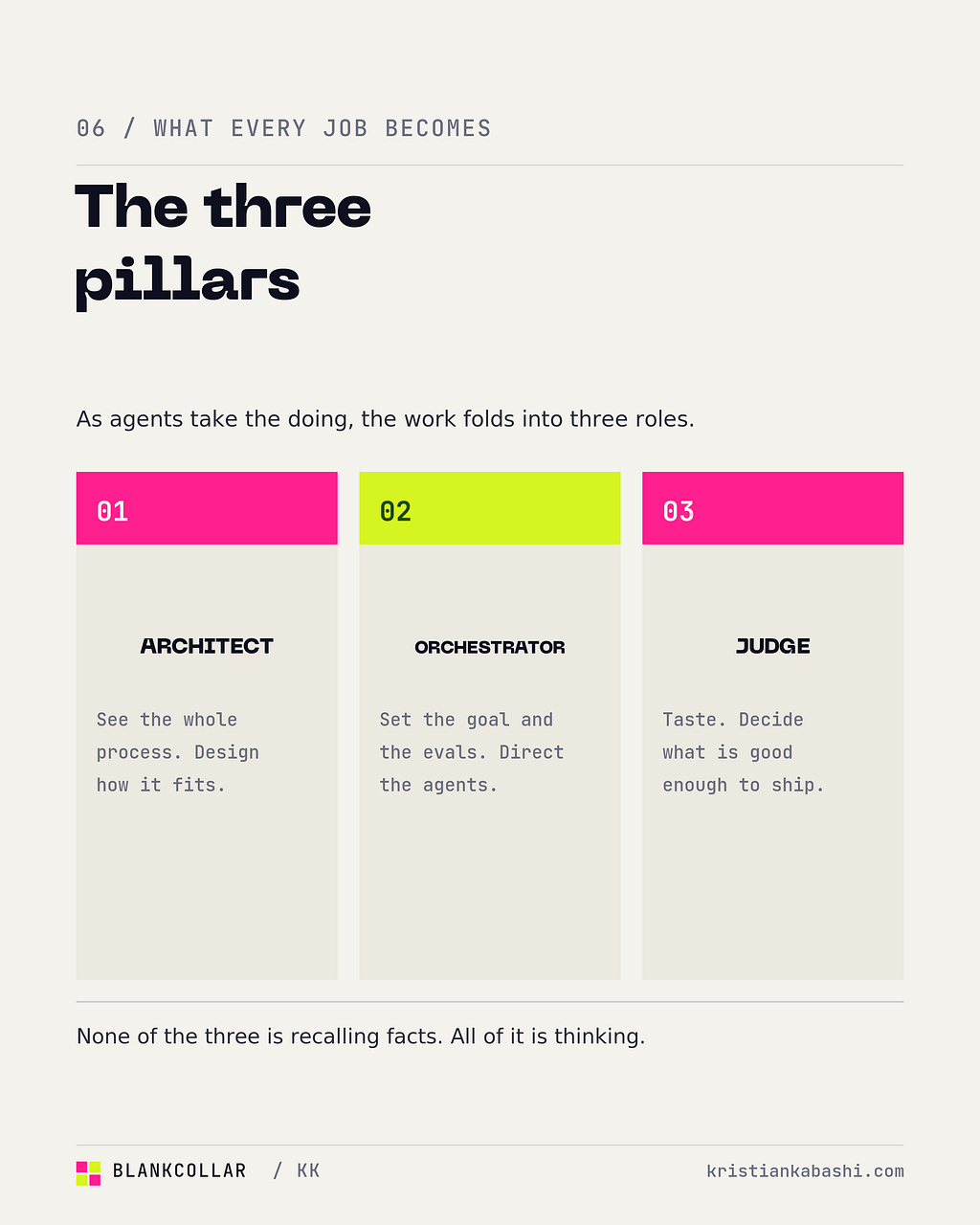
What are we actually educating people for, then. My honest answer is that the old job titles are melting together. As agents take the execution, the dozens of narrow roles a company used to have are folding into a few broad ones, and most people will end up doing the work of what used to be several jobs at once, mostly by directing software that does the doing. Strip it back and three pillars are left standing.
The first is the architect. The person who understands a process end to end, who can hold the whole system in their head and design how the pieces fit. When the machine can build any single piece, the value moves to whoever knows what should be built and how it connects.
The second is the orchestrator. The person who directs a fleet of agents the way a manager directs a team, setting the goal, defining what good looks like, writing the evaluations that tell you whether the output is actually any good, and stepping in where judgement is needed. Increasingly every employee is a manager now, just of software rather than people.
The third is the judge. Taste, in other words. When anyone can generate infinite options, the rare and valuable act is choosing, deciding what is good enough to ship and what should never see daylight. I have written a whole piece on why taste is the new moat, and it sits right at the top of this stack.
None of these three is about recalling facts. All of them are about thinking, designing, deciding. That is the curriculum. We should be teaching them at sixteen, not discovering them by accident at thirty.
Hard work is the new easy
One more uncomfortable truth, so nobody mistakes this for a utopia. As companies get smaller and one person can do what used to take a team, the work that is left for each human gets heavier, not lighter. The easy work, the routine and repeatable stuff, is exactly what the machines take first. What remains is the hard part, the judgement, the genuinely new problem, the thing with no template.
So the bar moves. What used to count as hard work, grinding through volume, becomes the easy baseline that a machine handles. The new normal is the work that used to be considered hard. And the actual goal, the place the gains are, is the ultra-hard work most people never had the time or space to attempt, because they were buried in the routine. That is the trade. Less drudgery, but far more responsibility resting on each person, and nowhere to hide. It is exciting if you are ready for it and brutal if you are not. The education system, as it stands, is preparing almost no one for it.
We are late, so start now
I do not think the system fixes itself in time. Legislation moves in years, and this is moving in weeks. By the time any ministry redesigns a national curriculum, the curriculum will be wrong again. So the move is not to wait for permission.
If you are a parent, stop treating the diploma as the goal and start treating capability as the goal. Get your kid building real things with these tools now, and protect their ability to read deeply and think without a screen, because that is the rare half of the equation. If you are a student, do not outsource your brain to the model. Use it to go further, not to avoid the work, and get real experience years before the calendar says you are allowed to. If you run a company, build the internal school you wish existed and look hard at talent that never got the traditional stamp. And whoever you are, learn how to learn, because that is the only skill with a half-life longer than the next model release.
The whole thing comes back to that inversion I started with. We can raise a generation of people who work for the AI, take what it gives them, and slowly forget how to think. Or we can raise people who direct it, argue with it, and use it to become more capable than any generation before them. Both futures are available right now, in the same tool, and we are choosing between them by default while we wait for someone official to tell us how. Work is for bots. Learning to think well enough to point them somewhere worth going is for us. And it needs to start a long time before 22.
Kristian Kabashi writes Blank Collar, a field guide for executives and the rest of us rethinking how work, companies, and now schools are built. More at kristiankabashi.com.
Sources: Federal Reserve Bank of New York, Labor Market for Recent College Graduates · Brynjolfsson, Chandar & Chen, “Canaries in the Coal Mine?”, Stanford Digital Economy Lab, Nov 2025 · Burning Glass Institute, “No Country for Young Grads,” July 2025 · SignalFire State of Talent Report 2025 · Dario Amodei interview, Axios, May 2025 · Burning Glass Institute, The Emerging Degree Reset · Brookings, States removing degree requirements · Swiss Confederation, Vocational education and training · Eurostat, EU unemployment 2024 · WEF Future of Jobs Report 2025 · Gloria Mark, Attention Span research, UC Irvine · Kosmyna et al., “Your Brain on ChatGPT,” MIT Media Lab, 2025 · Lee et al., Generative AI and Critical Thinking, Microsoft Research & CMU, CHI 2025 · Gerlich, AI Tools and Critical Thinking, Societies 2025 · Kestin et al., AI tutoring vs active learning, Scientific Reports 2025 · World Bank, “From Chalkboards to Chatbots,” 2025 · Bloom’s 2 Sigma Problem · Amazon Upskilling 2025 · Accenture LearnVantage, 2024