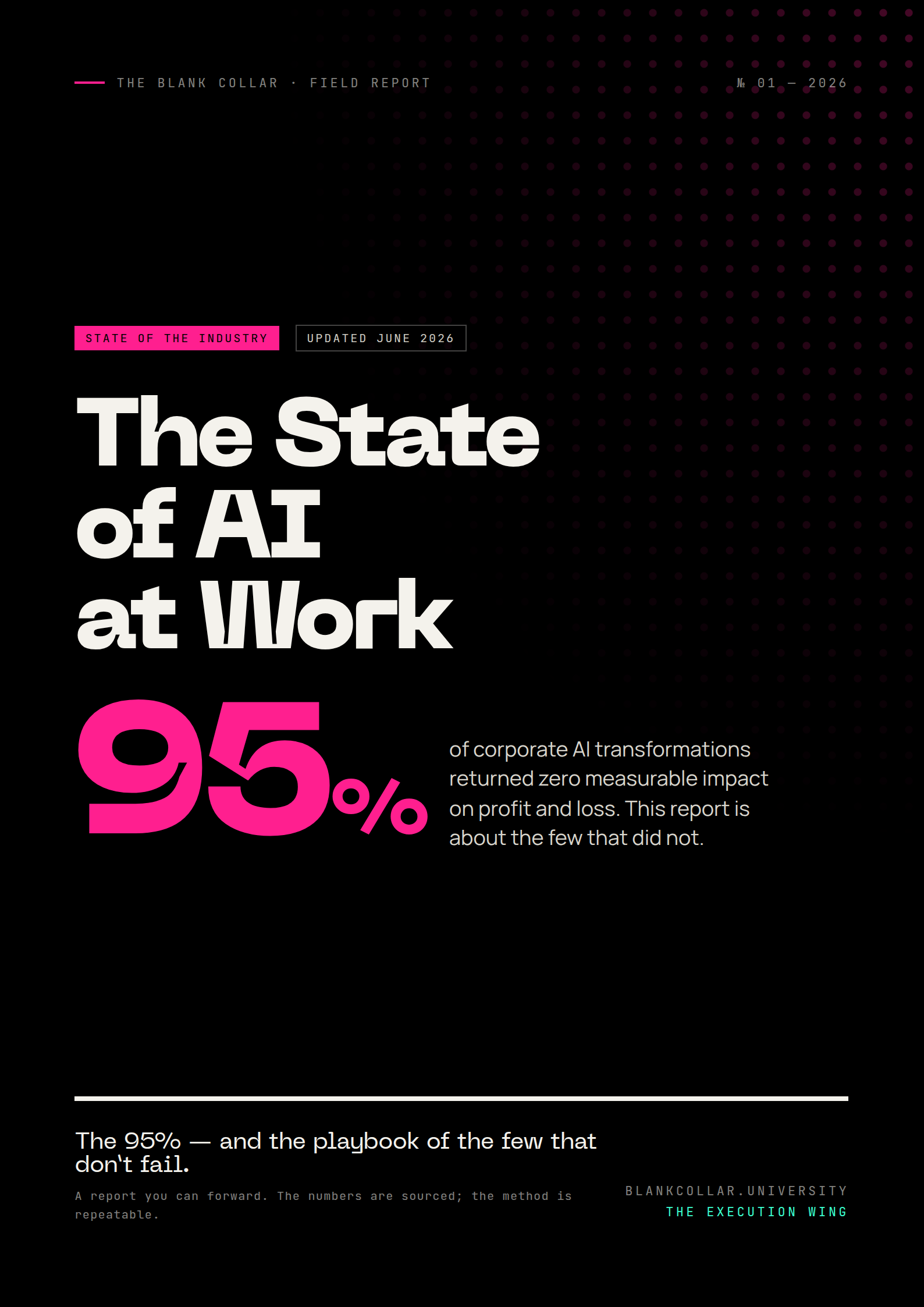
The State of AI at Work · 2026
The 95%: why most AI transformations fail, and the playbook of the few that don't.
What it is
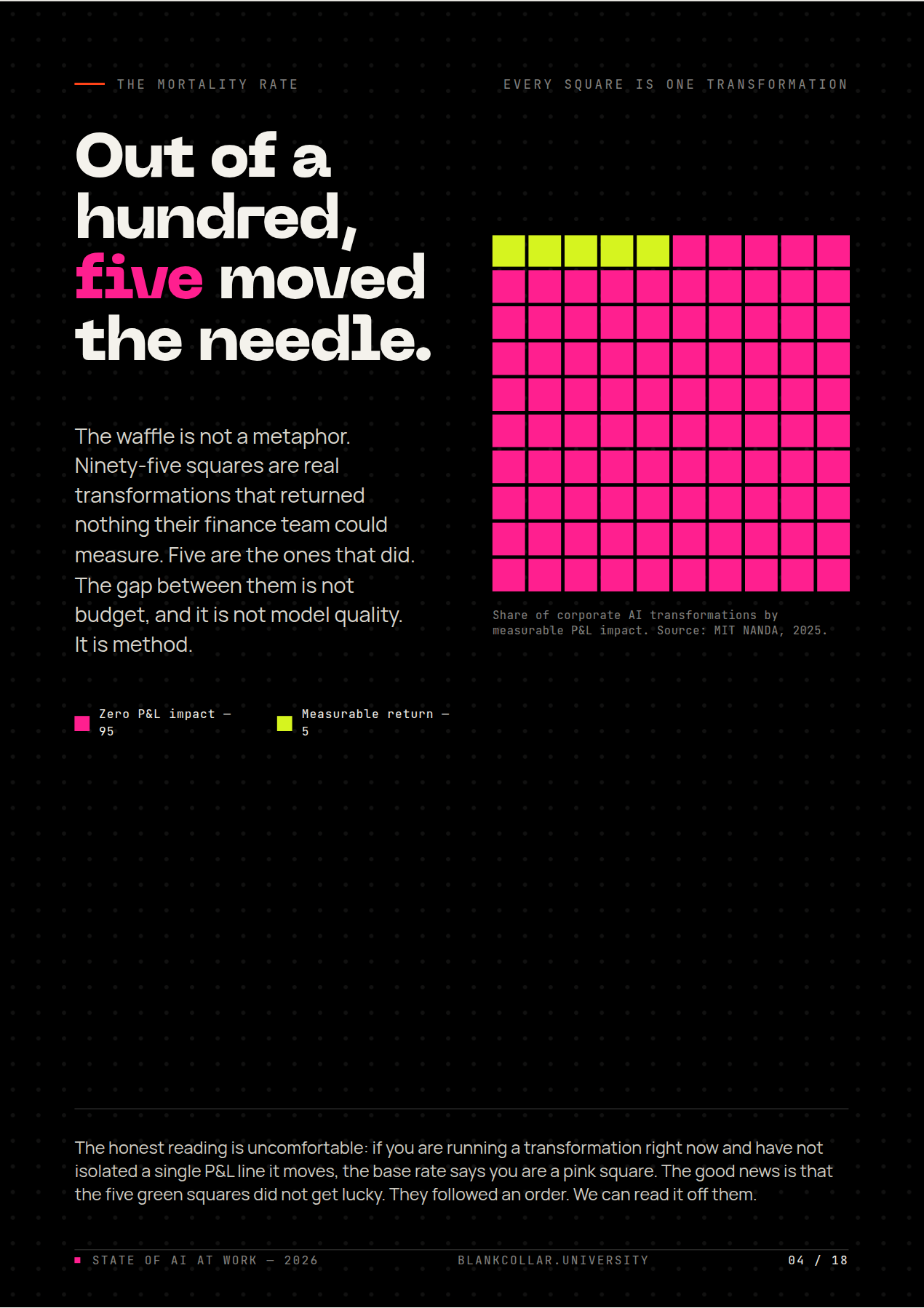
In 2025, MIT's NANDA team measured what the industry had avoided counting: 95% of corporate AI transformations returned zero measurable impact on profit and loss. McKinsey's own numbers say the same: adoption past 78%, earnings impact for fewer than one in five. The failure was never the model. It was a learning gap: the tools could not absorb how the company actually worked.
This is the field report behind that finding. It reads the three famous autopsies (McDonald's × IBM, Air Canada, Klarna) as three different organs failing, not one technology. It draws the Stack that explains why, runs the arithmetic of the exponent, and lays out the six moves and the 90-day protocol that separated the 5% from everyone else. Eighteen pages, every figure sourced, designed to be screenshotted and forwarded.
What’s inside
- 01The most expensive numberWhy 95% of transformations returned nothing, and what the 5% did instead.
- 02Three bodies on the tableMcDonald's, Air Canada, Klarna: a process, a governance, and a vision failure.
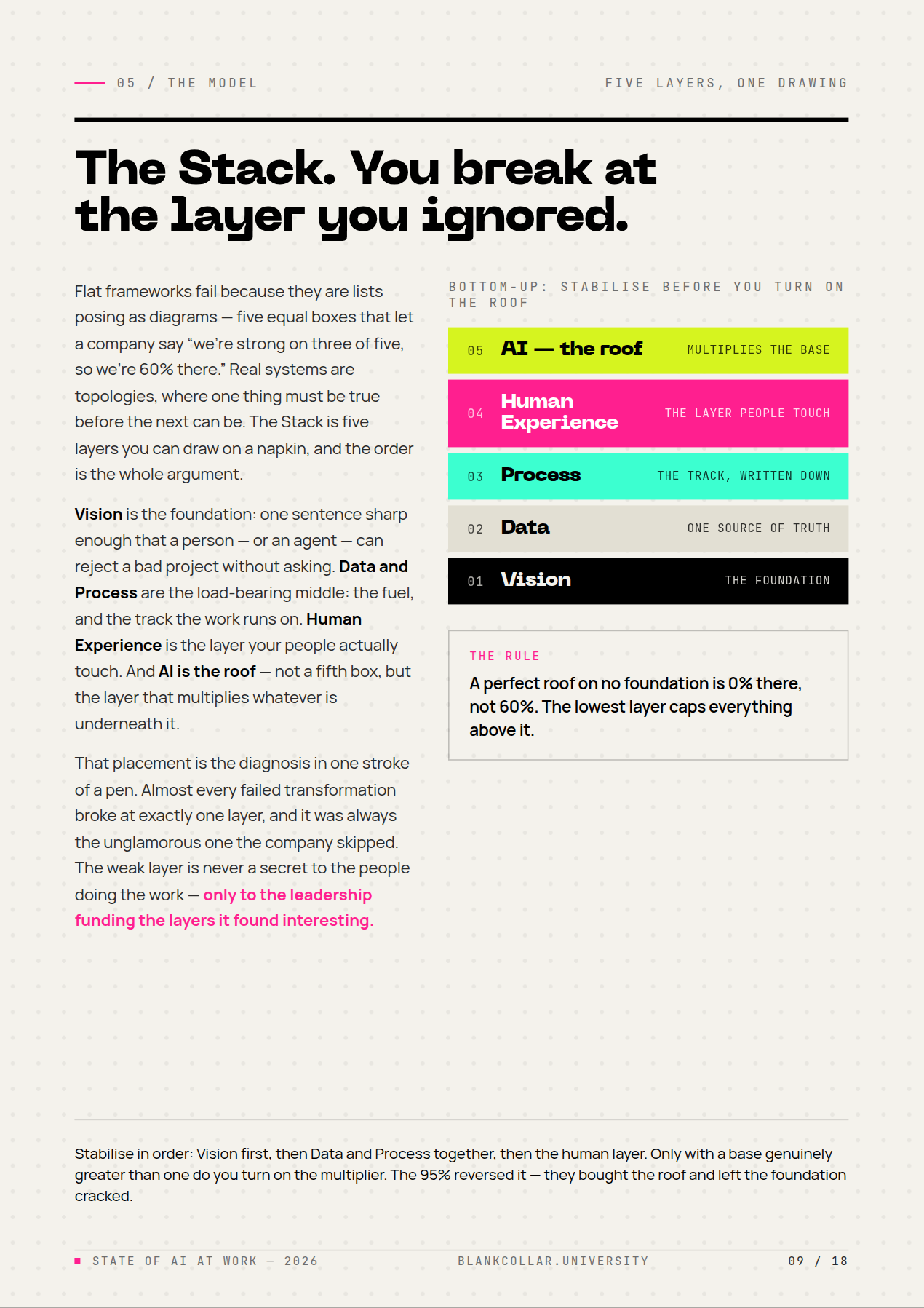
- 03The Stack and the exponentFive layers, one drawing, and why 2^10 and ½^10 decide everything.
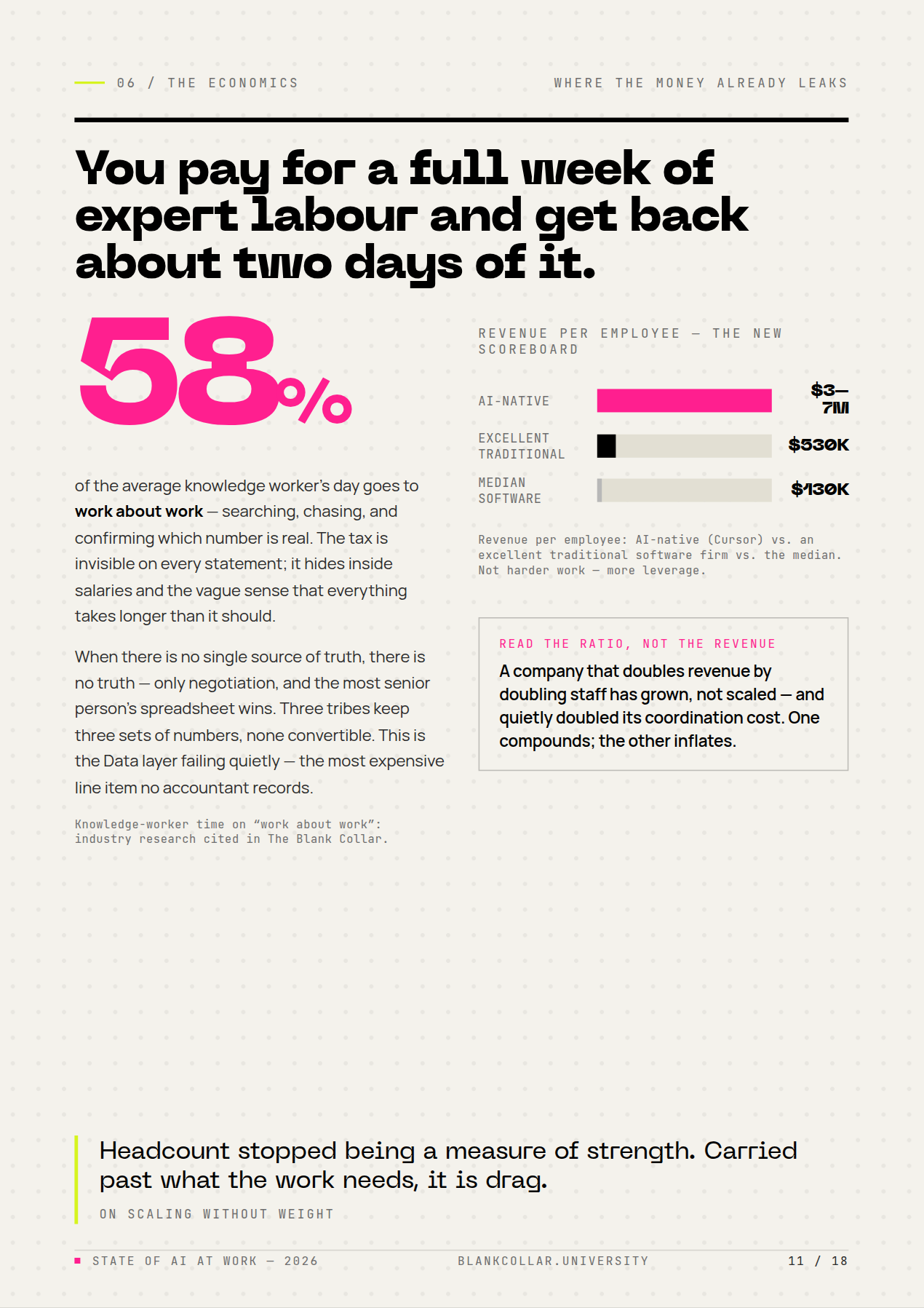
- 04The economics58% lost to work about work; $3–7M revenue per employee at AI-native firms vs ~$130K.
- 05The playbook of the 5%Six moves, the 90-day protocol, and the four audit bands out of 200.
How to use it
- Read it in one sitting (about twenty minutes), then forward it to whoever signs the transformation cheque.
- Score your own Stack against the four bands, then run The Index to place yourself.
Keep going.
The 5-Question AI Autopsy
An AI initiative failed, or is failing. Five questions, one per layer of the Stack, to find the layer that actually killed it. It is almost never the model.
Read more
The Stack: Brief Your Leadership in 10 Slides
The deck a manager opens, then presents: why most AI transformations fail, and the five layers that decide it. Forward-ready, every figure sourced.
Read more
The 90-Day Protocol
The first ninety days that separate the 5% from the 95%. The operating playbook the report points to (diagnose, fix the base, compound) on a calendar.
Read moreFree at the door.
Tools are the first layer of the Codex. The curriculum is where you put them to work, on your own role and your own real work.